Readings Newsletter
Become a Readings Member to make your shopping experience even easier.
Sign in or sign up for free!
You’re not far away from qualifying for FREE standard shipping within Australia
You’ve qualified for FREE standard shipping within Australia
The cart is loading…


This title is printed to order. This book may have been self-published. If so, we cannot guarantee the quality of the content. In the main most books will have gone through the editing process however some may not. We therefore suggest that you be aware of this before ordering this book. If in doubt check either the author or publisher’s details as we are unable to accept any returns unless they are faulty. Please contact us if you have any questions.
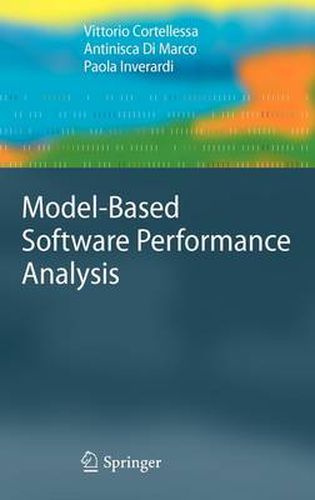
Poor performance is one of the main quality-related shortcomings that cause software projects to fail. Thus, the need to address performance concerns early during the software development process is fully acknowledged, and there is a growing interest in the research and software industry communities towards techniques, methods and tools that permit to manage system performance concerns as an integral part of software engineering. Model-based software performance analysis introduces performance concerns in the scope of software modeling, thus allowing the developer to carry on performance analysis throughout the software lifecycle.
With this book, Cortellessa, Di Marco and Inverardi provide the cross-knowledge that allows developers to tackle software performance issues from the very early phases of software development. They explain the basic concepts of performance analysis and describe the most representative methodologies used to annotate and transform software models into performance models. To this end, they go all the way from performance primers through software and performance modeling notations to the latest transformation-based methodologies.
As a result, their book is a self-contained reference text on software performance engineering, from which different target groups will benefit: professional software engineers and graduate students in software engineering will learn both basic concepts of performance modeling and new methodologies; while performance specialists will find out how to investigate software performance model building.
$9.00 standard shipping within Australia
FREE standard shipping within Australia for orders over $100.00
Express & International shipping calculated at checkout
Stock availability can be subject to change without notice. We recommend calling the shop or contacting our online team to check availability of low stock items. Please see our Shopping Online page for more details.
This title is printed to order. This book may have been self-published. If so, we cannot guarantee the quality of the content. In the main most books will have gone through the editing process however some may not. We therefore suggest that you be aware of this before ordering this book. If in doubt check either the author or publisher’s details as we are unable to accept any returns unless they are faulty. Please contact us if you have any questions.
Poor performance is one of the main quality-related shortcomings that cause software projects to fail. Thus, the need to address performance concerns early during the software development process is fully acknowledged, and there is a growing interest in the research and software industry communities towards techniques, methods and tools that permit to manage system performance concerns as an integral part of software engineering. Model-based software performance analysis introduces performance concerns in the scope of software modeling, thus allowing the developer to carry on performance analysis throughout the software lifecycle.
With this book, Cortellessa, Di Marco and Inverardi provide the cross-knowledge that allows developers to tackle software performance issues from the very early phases of software development. They explain the basic concepts of performance analysis and describe the most representative methodologies used to annotate and transform software models into performance models. To this end, they go all the way from performance primers through software and performance modeling notations to the latest transformation-based methodologies.
As a result, their book is a self-contained reference text on software performance engineering, from which different target groups will benefit: professional software engineers and graduate students in software engineering will learn both basic concepts of performance modeling and new methodologies; while performance specialists will find out how to investigate software performance model building.
Search our extensive online catalogue.
