Readings Newsletter
Become a Readings Member to make your shopping experience even easier.
Sign in or sign up for free!
You’re not far away from qualifying for FREE standard shipping within Australia
You’ve qualified for FREE standard shipping within Australia
The cart is loading…


This title is printed to order. This book may have been self-published. If so, we cannot guarantee the quality of the content. In the main most books will have gone through the editing process however some may not. We therefore suggest that you be aware of this before ordering this book. If in doubt check either the author or publisher’s details as we are unable to accept any returns unless they are faulty. Please contact us if you have any questions.
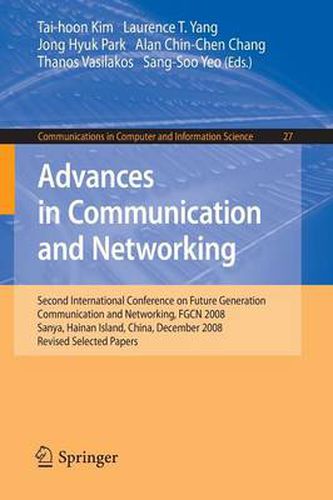
As computational science and engineering (CSE) become specialized and fragmented, it is easy to lose sight that many topics in CSE have common threads and because of this, advances in one sub-discipline may transmit to another. The presentation of - sults between different sub-disciplines of CSE encourages this interchange for the advancement of CSE as a whole. Of particular interest is the hybrid approach of c- bining ideas from one discipline with those of another to achieve a result that is more significant than the sum of the individual parts. Through this hybrid philosophy, a new or common principle can be discovered which has the propensity to propagate throughout this multifaceted discipline. This volume comprises the selection of extended versions of papers that were p- sented in their shortened form at the 2008 International Conference on Future Gene- tion Communication and Networking (http://www.sersc.org/FGCN2008/) and 2009 Advanced Science and Technology (http://www.sersc.org/AST2009/). We would like to acknowledge the great effort of all in the FGCN2008 and AST 2009 International Advisory Board and members of the International Program Committee, as well as all the organizations and individuals who supported the idea of publishing these advances in communication and networking, including SERSC (http://www.sersc.org/) and Springer. We would like to give special thanks to Rosslin John Robles, Maricel O. Balitanas, Farkhod Alisherov Alisherovish, Feruza Sattarova Yusfovna. These graduate school students of Hannam University attended to the editing process of this volume with great passion.
$9.00 standard shipping within Australia
FREE standard shipping within Australia for orders over $100.00
Express & International shipping calculated at checkout
Stock availability can be subject to change without notice. We recommend calling the shop or contacting our online team to check availability of low stock items. Please see our Shopping Online page for more details.
This title is printed to order. This book may have been self-published. If so, we cannot guarantee the quality of the content. In the main most books will have gone through the editing process however some may not. We therefore suggest that you be aware of this before ordering this book. If in doubt check either the author or publisher’s details as we are unable to accept any returns unless they are faulty. Please contact us if you have any questions.
As computational science and engineering (CSE) become specialized and fragmented, it is easy to lose sight that many topics in CSE have common threads and because of this, advances in one sub-discipline may transmit to another. The presentation of - sults between different sub-disciplines of CSE encourages this interchange for the advancement of CSE as a whole. Of particular interest is the hybrid approach of c- bining ideas from one discipline with those of another to achieve a result that is more significant than the sum of the individual parts. Through this hybrid philosophy, a new or common principle can be discovered which has the propensity to propagate throughout this multifaceted discipline. This volume comprises the selection of extended versions of papers that were p- sented in their shortened form at the 2008 International Conference on Future Gene- tion Communication and Networking (http://www.sersc.org/FGCN2008/) and 2009 Advanced Science and Technology (http://www.sersc.org/AST2009/). We would like to acknowledge the great effort of all in the FGCN2008 and AST 2009 International Advisory Board and members of the International Program Committee, as well as all the organizations and individuals who supported the idea of publishing these advances in communication and networking, including SERSC (http://www.sersc.org/) and Springer. We would like to give special thanks to Rosslin John Robles, Maricel O. Balitanas, Farkhod Alisherov Alisherovish, Feruza Sattarova Yusfovna. These graduate school students of Hannam University attended to the editing process of this volume with great passion.
Search our extensive online catalogue.
