Readings Newsletter
Become a Readings Member to make your shopping experience even easier.
Sign in or sign up for free!
You’re not far away from qualifying for FREE standard shipping within Australia
You’ve qualified for FREE standard shipping within Australia
The cart is loading…


This title is printed to order. This book may have been self-published. If so, we cannot guarantee the quality of the content. In the main most books will have gone through the editing process however some may not. We therefore suggest that you be aware of this before ordering this book. If in doubt check either the author or publisher’s details as we are unable to accept any returns unless they are faulty. Please contact us if you have any questions.
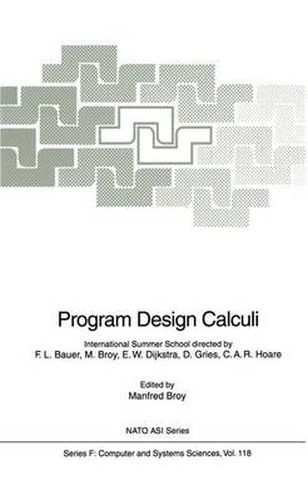
The development of information processing systems requires models, calculi, and theories for the analysis of computations. Complex software systems are best constructed in a careful, systematic, and disciplined structuring of the development process. Starting from basic requirement specifications in which all the relevant details are formalized, the envisaged solution should be developed step by step by adding more and more details and giving evidence or formal proofs to show the correctness of the steps, until a description of a solution is obtained that has all the required properties. The Marktoberdorf Advanced Study Institute 1992 presented scientific highlights in approaches to the systematic study ofreliable software and hardware systems using functional, algebraic, and logical calculi. Leading scientists treated the specification, development, verification, and implementation of complex time-sensitive systems, such as signal processing systems, process control systems, and general software systems. The mathematical foundations of specification and refinement were carefully treated, and several formalisms for describing processes were introduced. Emphasis was put on application-oriented descriptions of signal processing systems with real-time dependencies. Formalisms for reasoning about distributed causality-based computations were presented and new styles of programming leading to shorter and more expressive notations were demonstrated. This book is based on the Institute, and gives an impressive demonstration of the state of the art and the essential progress in our formal abilities to specify, refine, verify, develop, and implement complex software systems including embedded systems and hard real-time dependent systems.
$9.00 standard shipping within Australia
FREE standard shipping within Australia for orders over $100.00
Express & International shipping calculated at checkout
Stock availability can be subject to change without notice. We recommend calling the shop or contacting our online team to check availability of low stock items. Please see our Shopping Online page for more details.
This title is printed to order. This book may have been self-published. If so, we cannot guarantee the quality of the content. In the main most books will have gone through the editing process however some may not. We therefore suggest that you be aware of this before ordering this book. If in doubt check either the author or publisher’s details as we are unable to accept any returns unless they are faulty. Please contact us if you have any questions.
The development of information processing systems requires models, calculi, and theories for the analysis of computations. Complex software systems are best constructed in a careful, systematic, and disciplined structuring of the development process. Starting from basic requirement specifications in which all the relevant details are formalized, the envisaged solution should be developed step by step by adding more and more details and giving evidence or formal proofs to show the correctness of the steps, until a description of a solution is obtained that has all the required properties. The Marktoberdorf Advanced Study Institute 1992 presented scientific highlights in approaches to the systematic study ofreliable software and hardware systems using functional, algebraic, and logical calculi. Leading scientists treated the specification, development, verification, and implementation of complex time-sensitive systems, such as signal processing systems, process control systems, and general software systems. The mathematical foundations of specification and refinement were carefully treated, and several formalisms for describing processes were introduced. Emphasis was put on application-oriented descriptions of signal processing systems with real-time dependencies. Formalisms for reasoning about distributed causality-based computations were presented and new styles of programming leading to shorter and more expressive notations were demonstrated. This book is based on the Institute, and gives an impressive demonstration of the state of the art and the essential progress in our formal abilities to specify, refine, verify, develop, and implement complex software systems including embedded systems and hard real-time dependent systems.
Search our extensive online catalogue.
