Readings Newsletter
Become a Readings Member to make your shopping experience even easier.
Sign in or sign up for free!
You’re not far away from qualifying for FREE standard shipping within Australia
You’ve qualified for FREE standard shipping within Australia
The cart is loading…


This title is printed to order. This book may have been self-published. If so, we cannot guarantee the quality of the content. In the main most books will have gone through the editing process however some may not. We therefore suggest that you be aware of this before ordering this book. If in doubt check either the author or publisher’s details as we are unable to accept any returns unless they are faulty. Please contact us if you have any questions.
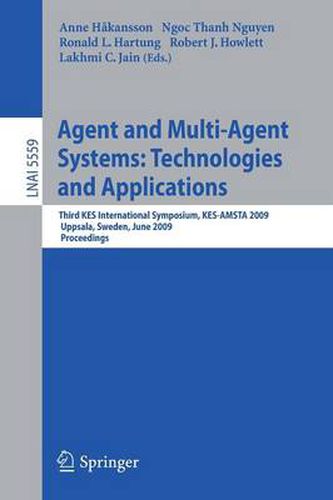
This volume contains the proceedings of the Third KES Symposium on Agent and Multi-agent Systems - Technologies and Applications (KES-AMSTA 2009)–held at Uppsala University in Sweden during June 3-5, 2009. The symposium was organized by Uppsala University, KES International and its Focus Group on Agent and Multi-agent Systems. The KES-AMSTA Symposium series is a sub-series of the KES Conference series. Following the successes of the First KES Symposium on Agent and Multi-agent Systems - Technologies and Applications (KES-AMSTA 2007), held in Wroclaw, Poland, from May 31 to 1 June 2007–and the Second KES Symposium on Agent and Multi-agent Systems - Technologies and Applications (KES-AMSTA 2008) held in Incheon, Korea, March 26-28, 2008–KES-AMSTA 2009 featured keynote talks, oral and poster presentations, and a number of workshops and invited sessions, closely aligned to the themes of the conference. The aim of the symposium was to provide an international forum for scientific - search into the technologies and applications of agent and multi-agent systems. Agent and multi-agent systems are an innovative type of modern software system and have long been recognized as a promising technology for constructing autonomous, c- plex and intelligent systems. A key development in the field of agent and multi-agent systems has been the specification of agent communication languages and formali- tion of ontologies. Agent communication languages are intended to provide standard declarative mechanisms for agents to communicate knowledge and make requests of each other, whereas ontologies are intended for conceptualization of the knowledge domain.
$9.00 standard shipping within Australia
FREE standard shipping within Australia for orders over $100.00
Express & International shipping calculated at checkout
Stock availability can be subject to change without notice. We recommend calling the shop or contacting our online team to check availability of low stock items. Please see our Shopping Online page for more details.
This title is printed to order. This book may have been self-published. If so, we cannot guarantee the quality of the content. In the main most books will have gone through the editing process however some may not. We therefore suggest that you be aware of this before ordering this book. If in doubt check either the author or publisher’s details as we are unable to accept any returns unless they are faulty. Please contact us if you have any questions.
This volume contains the proceedings of the Third KES Symposium on Agent and Multi-agent Systems - Technologies and Applications (KES-AMSTA 2009)–held at Uppsala University in Sweden during June 3-5, 2009. The symposium was organized by Uppsala University, KES International and its Focus Group on Agent and Multi-agent Systems. The KES-AMSTA Symposium series is a sub-series of the KES Conference series. Following the successes of the First KES Symposium on Agent and Multi-agent Systems - Technologies and Applications (KES-AMSTA 2007), held in Wroclaw, Poland, from May 31 to 1 June 2007–and the Second KES Symposium on Agent and Multi-agent Systems - Technologies and Applications (KES-AMSTA 2008) held in Incheon, Korea, March 26-28, 2008–KES-AMSTA 2009 featured keynote talks, oral and poster presentations, and a number of workshops and invited sessions, closely aligned to the themes of the conference. The aim of the symposium was to provide an international forum for scientific - search into the technologies and applications of agent and multi-agent systems. Agent and multi-agent systems are an innovative type of modern software system and have long been recognized as a promising technology for constructing autonomous, c- plex and intelligent systems. A key development in the field of agent and multi-agent systems has been the specification of agent communication languages and formali- tion of ontologies. Agent communication languages are intended to provide standard declarative mechanisms for agents to communicate knowledge and make requests of each other, whereas ontologies are intended for conceptualization of the knowledge domain.
Search our extensive online catalogue.
