Readings Newsletter
Become a Readings Member to make your shopping experience even easier.
Sign in or sign up for free!
You’re not far away from qualifying for FREE standard shipping within Australia
You’ve qualified for FREE standard shipping within Australia
The cart is loading…


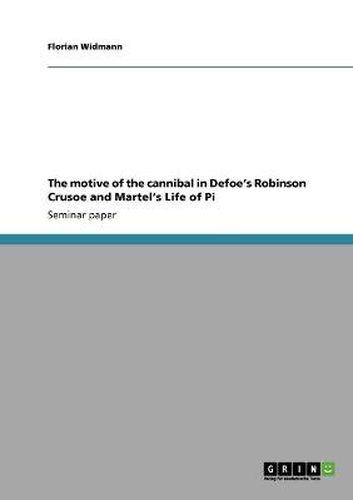
Seminar paper from the year 2008 in the subject English Language and Literature Studies - Literature, grade: 1,7, LMU Munich (Department fur Anglistik und Amerikanistik), course: Hauptseminar; Shipwrecks, language: English, abstract: The following paper deals with cannibals. A topic which is very unlikely to concern the normal European citizen of today, yet the thought of people consuming other people is fascinating, for it seems to follow mankind throughout its history, in culture and also to a great deal in literature. Surprisingly, it never seems to occur in front of our eyes, and only very seldom a reliable witness for such practises can be found. It is something that happens on the borders and in the shadows of societies. Nobody can imagine that anyone could openly confess or practise cannibalism, without being persecuted to the fullest extent of the given law. Cannibalism is considered a horrible crime that touches us deeply and which cannot be forgiven. Committing it is not only a huge crime against our moral standards, it often goes hand in hand with other crimes like murder and various pervert behaviour. Whoever commits this crime may not even be considered human anymore and may be treated like an animal, for it seems to be the ultimate borderline between men and beasts. It therefore can also be used as an instrument of defaming others, because unfortunately the basic principle of in dubio pro reo does not work here. Once accused, it is very hard to get rid of the fame of a crime that is generally considered to take place unseen…
$9.00 standard shipping within Australia
FREE standard shipping within Australia for orders over $100.00
Express & International shipping calculated at checkout
Stock availability can be subject to change without notice. We recommend calling the shop or contacting our online team to check availability of low stock items. Please see our Shopping Online page for more details.
Seminar paper from the year 2008 in the subject English Language and Literature Studies - Literature, grade: 1,7, LMU Munich (Department fur Anglistik und Amerikanistik), course: Hauptseminar; Shipwrecks, language: English, abstract: The following paper deals with cannibals. A topic which is very unlikely to concern the normal European citizen of today, yet the thought of people consuming other people is fascinating, for it seems to follow mankind throughout its history, in culture and also to a great deal in literature. Surprisingly, it never seems to occur in front of our eyes, and only very seldom a reliable witness for such practises can be found. It is something that happens on the borders and in the shadows of societies. Nobody can imagine that anyone could openly confess or practise cannibalism, without being persecuted to the fullest extent of the given law. Cannibalism is considered a horrible crime that touches us deeply and which cannot be forgiven. Committing it is not only a huge crime against our moral standards, it often goes hand in hand with other crimes like murder and various pervert behaviour. Whoever commits this crime may not even be considered human anymore and may be treated like an animal, for it seems to be the ultimate borderline between men and beasts. It therefore can also be used as an instrument of defaming others, because unfortunately the basic principle of in dubio pro reo does not work here. Once accused, it is very hard to get rid of the fame of a crime that is generally considered to take place unseen…
Search our extensive online catalogue.
