Readings Newsletter
Become a Readings Member to make your shopping experience even easier.
Sign in or sign up for free!
You’re not far away from qualifying for FREE standard shipping within Australia
You’ve qualified for FREE standard shipping within Australia
The cart is loading…


This title is printed to order. This book may have been self-published. If so, we cannot guarantee the quality of the content. In the main most books will have gone through the editing process however some may not. We therefore suggest that you be aware of this before ordering this book. If in doubt check either the author or publisher’s details as we are unable to accept any returns unless they are faulty. Please contact us if you have any questions.
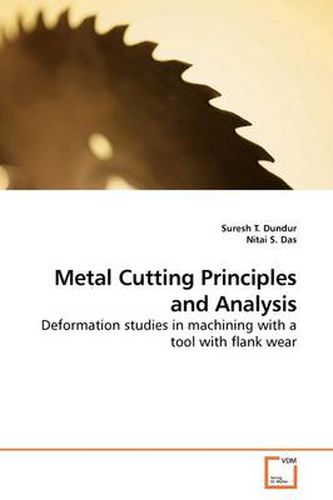
In recent times a lot of interest has been directed to the study of tool wear due to its influence on the technological performance of machining operations such as tool life, cutting forces, cutting power and surface finish. These studies have mostly been guided by an ever increasing demand for design of more efficient machine tools and cutting tools and due to increased use of unmanned machining centres where on- line monitoring of tool condition is very vital.The present text provides an exhaustive analysis of the chip forming process while machining with a worn tool using the rigid-plastic slipline field theory. Tool-chip interface friction is assumed to be adhesion and the fields are analysed by the matrix operational procedure with and without the assumption of an elastic contact region both for machining with chip curl and also for the case, when the chip streams past the cutting tool producing the straight chip. The book provides enough information on the effect of tool wear on cutting forces, force ratio and interface coulomb’s friction and is bound to be of value to those engaged in metal cutting research both in industry and academia.
$9.00 standard shipping within Australia
FREE standard shipping within Australia for orders over $100.00
Express & International shipping calculated at checkout
Stock availability can be subject to change without notice. We recommend calling the shop or contacting our online team to check availability of low stock items. Please see our Shopping Online page for more details.
This title is printed to order. This book may have been self-published. If so, we cannot guarantee the quality of the content. In the main most books will have gone through the editing process however some may not. We therefore suggest that you be aware of this before ordering this book. If in doubt check either the author or publisher’s details as we are unable to accept any returns unless they are faulty. Please contact us if you have any questions.
In recent times a lot of interest has been directed to the study of tool wear due to its influence on the technological performance of machining operations such as tool life, cutting forces, cutting power and surface finish. These studies have mostly been guided by an ever increasing demand for design of more efficient machine tools and cutting tools and due to increased use of unmanned machining centres where on- line monitoring of tool condition is very vital.The present text provides an exhaustive analysis of the chip forming process while machining with a worn tool using the rigid-plastic slipline field theory. Tool-chip interface friction is assumed to be adhesion and the fields are analysed by the matrix operational procedure with and without the assumption of an elastic contact region both for machining with chip curl and also for the case, when the chip streams past the cutting tool producing the straight chip. The book provides enough information on the effect of tool wear on cutting forces, force ratio and interface coulomb’s friction and is bound to be of value to those engaged in metal cutting research both in industry and academia.
Search our extensive online catalogue.
