Readings Newsletter
Become a Readings Member to make your shopping experience even easier.
Sign in or sign up for free!
You’re not far away from qualifying for FREE standard shipping within Australia
You’ve qualified for FREE standard shipping within Australia
The cart is loading…


This title is printed to order. This book may have been self-published. If so, we cannot guarantee the quality of the content. In the main most books will have gone through the editing process however some may not. We therefore suggest that you be aware of this before ordering this book. If in doubt check either the author or publisher’s details as we are unable to accept any returns unless they are faulty. Please contact us if you have any questions.
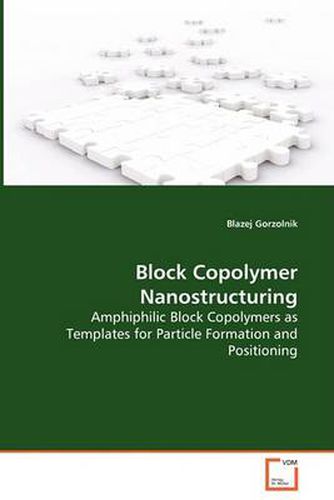
Block copolymers are fascinating materials that have attracted a lot of attention in recent years, as a consequence of their ability to serve as ideal building blocks to fabricate nanostructures. They are macro-molecules consisting of chemically different parts (blocks) that tend to self-assembly into well-ordered nanoscaled structures both in bulk and in a selective solvent for one of the block. In this thesis, amphiphilic block copolymers were successfully applied as templates for the controlled formation and defined positioning of metal and metal oxide nanoparticles arranged in periodic patterns on flat surfaces and in polymer nanofibre structures. Furthermore, a method was developed to arrange nanoparticles in desired nano-structured micropatterns on flat substrates using the combinations of top_down and bottom-up approaches: a self-assembled monolayer of hexagonally ordered block copolymer micelles loaded with gold precursor salt was used as a resist for lithography. Two diffrent energy sources were applied to selectively modify and pin the micelles to the substrate: UV light and s Focus Ion Beam.
$9.00 standard shipping within Australia
FREE standard shipping within Australia for orders over $100.00
Express & International shipping calculated at checkout
Stock availability can be subject to change without notice. We recommend calling the shop or contacting our online team to check availability of low stock items. Please see our Shopping Online page for more details.
This title is printed to order. This book may have been self-published. If so, we cannot guarantee the quality of the content. In the main most books will have gone through the editing process however some may not. We therefore suggest that you be aware of this before ordering this book. If in doubt check either the author or publisher’s details as we are unable to accept any returns unless they are faulty. Please contact us if you have any questions.
Block copolymers are fascinating materials that have attracted a lot of attention in recent years, as a consequence of their ability to serve as ideal building blocks to fabricate nanostructures. They are macro-molecules consisting of chemically different parts (blocks) that tend to self-assembly into well-ordered nanoscaled structures both in bulk and in a selective solvent for one of the block. In this thesis, amphiphilic block copolymers were successfully applied as templates for the controlled formation and defined positioning of metal and metal oxide nanoparticles arranged in periodic patterns on flat surfaces and in polymer nanofibre structures. Furthermore, a method was developed to arrange nanoparticles in desired nano-structured micropatterns on flat substrates using the combinations of top_down and bottom-up approaches: a self-assembled monolayer of hexagonally ordered block copolymer micelles loaded with gold precursor salt was used as a resist for lithography. Two diffrent energy sources were applied to selectively modify and pin the micelles to the substrate: UV light and s Focus Ion Beam.
Search our extensive online catalogue.
