Readings Newsletter
Become a Readings Member to make your shopping experience even easier.
Sign in or sign up for free!
You’re not far away from qualifying for FREE standard shipping within Australia
You’ve qualified for FREE standard shipping within Australia
The cart is loading…


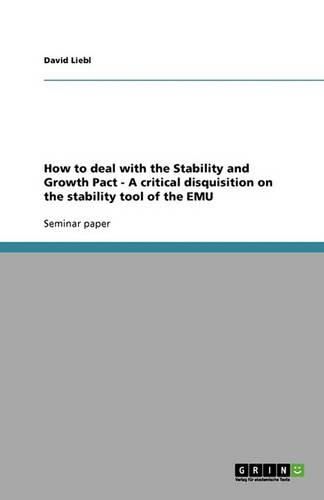
Seminar paper from the year 2005 in the subject Politics - International Politics - Topic: European Union, grade: A, University of Copenhagen (Departement of Political Science Copenhagen), course: Financial Globalization, 14 entries in the bibliography, language: English, abstract: Within the field of International Political Economy the case of monetary unions has become a big issue. Especially the establishment of the EMU has led to numerous academic publications. An intense political but also scientific discussion arose about the Stability and Growth Pact of the European Monetary Union. In March 2005 the ministers of finance and economics of the European Union decided to form the Stability and Growth Pact in a more flexible way. In the future countries that are above the 3 % limit should be judged as individual cases. In the academic discussion few economists already claim this, to be the pacts death. The paper starts by providing some basic facts about the terms of the pact and it’s application during the last years. Chapter 4 provides a short overview about the theoretical background to the field, which can be simplified as Monetarism vs. Keynesian Economics. The main research question is, how we should deal with the pact. Should it be kept like it is today? Or are there good options to change the pact? In chapter 5 I will point out the most important arguments for keeping the pact and for changing it. Chapter 6 finally goes into the latest academic discussion about a reform of the pact and presents different approaches in doing so.
$9.00 standard shipping within Australia
FREE standard shipping within Australia for orders over $100.00
Express & International shipping calculated at checkout
Stock availability can be subject to change without notice. We recommend calling the shop or contacting our online team to check availability of low stock items. Please see our Shopping Online page for more details.
Seminar paper from the year 2005 in the subject Politics - International Politics - Topic: European Union, grade: A, University of Copenhagen (Departement of Political Science Copenhagen), course: Financial Globalization, 14 entries in the bibliography, language: English, abstract: Within the field of International Political Economy the case of monetary unions has become a big issue. Especially the establishment of the EMU has led to numerous academic publications. An intense political but also scientific discussion arose about the Stability and Growth Pact of the European Monetary Union. In March 2005 the ministers of finance and economics of the European Union decided to form the Stability and Growth Pact in a more flexible way. In the future countries that are above the 3 % limit should be judged as individual cases. In the academic discussion few economists already claim this, to be the pacts death. The paper starts by providing some basic facts about the terms of the pact and it’s application during the last years. Chapter 4 provides a short overview about the theoretical background to the field, which can be simplified as Monetarism vs. Keynesian Economics. The main research question is, how we should deal with the pact. Should it be kept like it is today? Or are there good options to change the pact? In chapter 5 I will point out the most important arguments for keeping the pact and for changing it. Chapter 6 finally goes into the latest academic discussion about a reform of the pact and presents different approaches in doing so.
Search our extensive online catalogue.
