Readings Newsletter
Become a Readings Member to make your shopping experience even easier.
Sign in or sign up for free!
You’re not far away from qualifying for FREE standard shipping within Australia
You’ve qualified for FREE standard shipping within Australia
The cart is loading…


This title is printed to order. This book may have been self-published. If so, we cannot guarantee the quality of the content. In the main most books will have gone through the editing process however some may not. We therefore suggest that you be aware of this before ordering this book. If in doubt check either the author or publisher’s details as we are unable to accept any returns unless they are faulty. Please contact us if you have any questions.
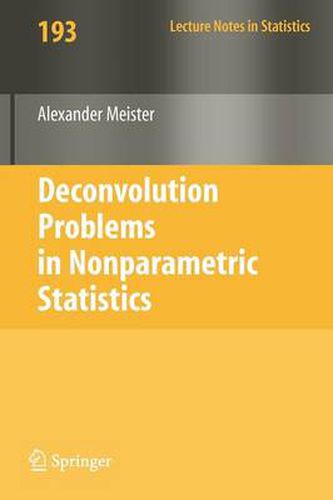
Deconvolution problems occur in many ?elds of nonparametric statistics, for example, density estimation based on contaminated data, nonparametric - gression with errors-in-variables, image and signal deblurring. During the last two decades, those topics have received more and more attention. As appli- tions of deconvolution procedures concern many real-life problems in eco- metrics, biometrics, medical statistics, image reconstruction, one can realize an increasing number of applied statisticians who are interested in nonpa- metric deconvolution methods; on the other hand, some deep results from Fourier analysis, functional analysis, and probability theory are required to understand the construction of deconvolution techniques and their properties so that deconvolution is also particularly challenging for mathematicians. Thegeneraldeconvolutionprobleminstatisticscanbedescribedasfollows: Our goal is estimating a function f while any empirical access is restricted to some quantity h = f?G = f(x?y)dG(y), (1. 1) that is, the convolution of f and some probability distribution G. Therefore, f can be estimated from some observations only indirectly. The strategy is estimating h ?rst; this means producing an empirical version h of h and, then, applying a deconvolution procedure to h to estimate f. In the mathematical context, we have to invert the convolution operator with G where some reg- ularization is required to guarantee that h is contained in the invertibility domain of the convolution operator. The estimator h has to be chosen with respect to the speci?c statistical experiment.
$9.00 standard shipping within Australia
FREE standard shipping within Australia for orders over $100.00
Express & International shipping calculated at checkout
Stock availability can be subject to change without notice. We recommend calling the shop or contacting our online team to check availability of low stock items. Please see our Shopping Online page for more details.
This title is printed to order. This book may have been self-published. If so, we cannot guarantee the quality of the content. In the main most books will have gone through the editing process however some may not. We therefore suggest that you be aware of this before ordering this book. If in doubt check either the author or publisher’s details as we are unable to accept any returns unless they are faulty. Please contact us if you have any questions.
Deconvolution problems occur in many ?elds of nonparametric statistics, for example, density estimation based on contaminated data, nonparametric - gression with errors-in-variables, image and signal deblurring. During the last two decades, those topics have received more and more attention. As appli- tions of deconvolution procedures concern many real-life problems in eco- metrics, biometrics, medical statistics, image reconstruction, one can realize an increasing number of applied statisticians who are interested in nonpa- metric deconvolution methods; on the other hand, some deep results from Fourier analysis, functional analysis, and probability theory are required to understand the construction of deconvolution techniques and their properties so that deconvolution is also particularly challenging for mathematicians. Thegeneraldeconvolutionprobleminstatisticscanbedescribedasfollows: Our goal is estimating a function f while any empirical access is restricted to some quantity h = f?G = f(x?y)dG(y), (1. 1) that is, the convolution of f and some probability distribution G. Therefore, f can be estimated from some observations only indirectly. The strategy is estimating h ?rst; this means producing an empirical version h of h and, then, applying a deconvolution procedure to h to estimate f. In the mathematical context, we have to invert the convolution operator with G where some reg- ularization is required to guarantee that h is contained in the invertibility domain of the convolution operator. The estimator h has to be chosen with respect to the speci?c statistical experiment.
Search our extensive online catalogue.
