Readings Newsletter
Become a Readings Member to make your shopping experience even easier.
Sign in or sign up for free!
You’re not far away from qualifying for FREE standard shipping within Australia
You’ve qualified for FREE standard shipping within Australia
The cart is loading…


This title is printed to order. This book may have been self-published. If so, we cannot guarantee the quality of the content. In the main most books will have gone through the editing process however some may not. We therefore suggest that you be aware of this before ordering this book. If in doubt check either the author or publisher’s details as we are unable to accept any returns unless they are faulty. Please contact us if you have any questions.
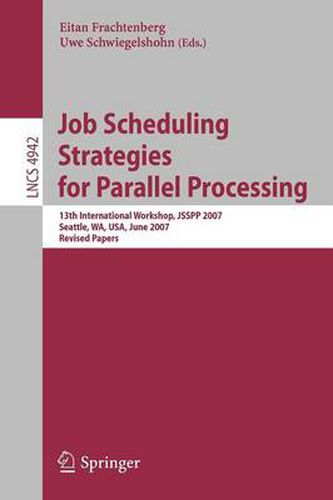
th Thisvolumecontainsthepaperspresentedatthe13 workshoponJobSched- ing Strategies for Parallel Processing. The workshop was held in Seattle, WA, USA, on June 17, 2007, in conjunction with ICS 2007. All submitted papers went through a complete review process, with the full versionbeingreadandevaluatedbyanaverageof?vereviewers.Wewouldliketo thanktheProgramCommittee membersandadditionalrefereesfortheirwilli- ness to participate in this e?ort and their excellent, detailed reviews: Nazareno Andrade, Su-Hui Chiang, Walfredo Cirne, Alvaro Coelho, Lauro Costa, Dror Feitelson, Allan Gottlieb, Andrew Grimshaw, Moe Jette, Richard Lagerstrom, Virginia Lo, Reagan Moore, Bill Nitzberg, Mark Squillante, John Towns, Jon Weissman, and Ramin Yahyapour. The accepted workshop papers in recent years show a departure from the supercomputer-centric viewpoint of parallel job scheduling. On the one hand, the ?eld of supercomputer scheduling is showing some signs of maturity, exh- ited in many widely accepted practices for job scheduling. On the other hand, many nontraditionalhigh-performancecomputing andparallelenvironments are emerging as viable solutions to many users and uses that cannot or need not - cess a traditional supercomputer, such as Grids, Web services, and commodity parallelcomputers.With the growingubiquity ofthese technologies,the requi- ment to schedule parallel jobs well on these various architectures also grows.
$9.00 standard shipping within Australia
FREE standard shipping within Australia for orders over $100.00
Express & International shipping calculated at checkout
Stock availability can be subject to change without notice. We recommend calling the shop or contacting our online team to check availability of low stock items. Please see our Shopping Online page for more details.
This title is printed to order. This book may have been self-published. If so, we cannot guarantee the quality of the content. In the main most books will have gone through the editing process however some may not. We therefore suggest that you be aware of this before ordering this book. If in doubt check either the author or publisher’s details as we are unable to accept any returns unless they are faulty. Please contact us if you have any questions.
th Thisvolumecontainsthepaperspresentedatthe13 workshoponJobSched- ing Strategies for Parallel Processing. The workshop was held in Seattle, WA, USA, on June 17, 2007, in conjunction with ICS 2007. All submitted papers went through a complete review process, with the full versionbeingreadandevaluatedbyanaverageof?vereviewers.Wewouldliketo thanktheProgramCommittee membersandadditionalrefereesfortheirwilli- ness to participate in this e?ort and their excellent, detailed reviews: Nazareno Andrade, Su-Hui Chiang, Walfredo Cirne, Alvaro Coelho, Lauro Costa, Dror Feitelson, Allan Gottlieb, Andrew Grimshaw, Moe Jette, Richard Lagerstrom, Virginia Lo, Reagan Moore, Bill Nitzberg, Mark Squillante, John Towns, Jon Weissman, and Ramin Yahyapour. The accepted workshop papers in recent years show a departure from the supercomputer-centric viewpoint of parallel job scheduling. On the one hand, the ?eld of supercomputer scheduling is showing some signs of maturity, exh- ited in many widely accepted practices for job scheduling. On the other hand, many nontraditionalhigh-performancecomputing andparallelenvironments are emerging as viable solutions to many users and uses that cannot or need not - cess a traditional supercomputer, such as Grids, Web services, and commodity parallelcomputers.With the growingubiquity ofthese technologies,the requi- ment to schedule parallel jobs well on these various architectures also grows.
Search our extensive online catalogue.
