Readings Newsletter
Become a Readings Member to make your shopping experience even easier.
Sign in or sign up for free!
You’re not far away from qualifying for FREE standard shipping within Australia
You’ve qualified for FREE standard shipping within Australia
The cart is loading…


This title is printed to order. This book may have been self-published. If so, we cannot guarantee the quality of the content. In the main most books will have gone through the editing process however some may not. We therefore suggest that you be aware of this before ordering this book. If in doubt check either the author or publisher’s details as we are unable to accept any returns unless they are faulty. Please contact us if you have any questions.
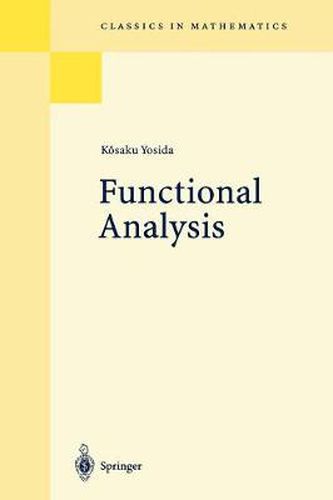
The present book is based on lectures given by the author at the University of Tokyo during the past ten years. It is intended as a textbook to be studied by students on their own or to be used in a course on Functional Analysis, i. e. , the general theory of linear operators in function spaces together with salient features of its application to diverse fields of modern and classical analysis. Necessary prerequisites for the reading of this book are summarized, with or without proof, in Chapter 0 under titles: Set Theory, Topo logical Spaces, Measure Spaces and Linear Spaces. Then, starting with the chapter on Semi-norms, a general theory of Banach and Hilbert spaces is presented in connection with the theory of generalized functions of S. L. SOBOLEV and L. SCHWARTZ. While the book is primarily addressed to graduate students, it is hoped it might prove useful to research mathe maticians, both pure and applied. The reader may pass, e. g. , from Chapter IX (Analytical Theory of Semi-groups) directly to Chapter XIII (Ergodic Theory and Diffusion Theory) and to Chapter XIV (Integration of the Equation of Evolution). Such materials as Weak Topologies and Duality in Locally Convex Spaces and Nuclear Spaces are presented in the form of the appendices to Chapter V and Chapter X, respectively. These might be skipped for the first reading by those who are interested rather in the application of linear operators.
$9.00 standard shipping within Australia
FREE standard shipping within Australia for orders over $100.00
Express & International shipping calculated at checkout
Stock availability can be subject to change without notice. We recommend calling the shop or contacting our online team to check availability of low stock items. Please see our Shopping Online page for more details.
This title is printed to order. This book may have been self-published. If so, we cannot guarantee the quality of the content. In the main most books will have gone through the editing process however some may not. We therefore suggest that you be aware of this before ordering this book. If in doubt check either the author or publisher’s details as we are unable to accept any returns unless they are faulty. Please contact us if you have any questions.
The present book is based on lectures given by the author at the University of Tokyo during the past ten years. It is intended as a textbook to be studied by students on their own or to be used in a course on Functional Analysis, i. e. , the general theory of linear operators in function spaces together with salient features of its application to diverse fields of modern and classical analysis. Necessary prerequisites for the reading of this book are summarized, with or without proof, in Chapter 0 under titles: Set Theory, Topo logical Spaces, Measure Spaces and Linear Spaces. Then, starting with the chapter on Semi-norms, a general theory of Banach and Hilbert spaces is presented in connection with the theory of generalized functions of S. L. SOBOLEV and L. SCHWARTZ. While the book is primarily addressed to graduate students, it is hoped it might prove useful to research mathe maticians, both pure and applied. The reader may pass, e. g. , from Chapter IX (Analytical Theory of Semi-groups) directly to Chapter XIII (Ergodic Theory and Diffusion Theory) and to Chapter XIV (Integration of the Equation of Evolution). Such materials as Weak Topologies and Duality in Locally Convex Spaces and Nuclear Spaces are presented in the form of the appendices to Chapter V and Chapter X, respectively. These might be skipped for the first reading by those who are interested rather in the application of linear operators.
Search our extensive online catalogue.
