Readings Newsletter
Become a Readings Member to make your shopping experience even easier.
Sign in or sign up for free!
You’re not far away from qualifying for FREE standard shipping within Australia
You’ve qualified for FREE standard shipping within Australia
The cart is loading…


This title is printed to order. This book may have been self-published. If so, we cannot guarantee the quality of the content. In the main most books will have gone through the editing process however some may not. We therefore suggest that you be aware of this before ordering this book. If in doubt check either the author or publisher’s details as we are unable to accept any returns unless they are faulty. Please contact us if you have any questions.
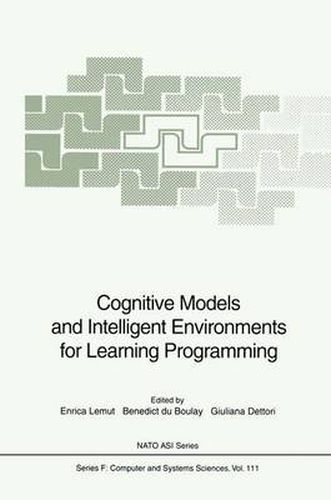
At present, there is a general consensus on the nature oflearning programming, but there are different opinions onwhat forms an effective environment for it. It is generallyrecognized that the development of a mental model is aformidable task for the student and that learningprogramming is a complex activity that depends heavily onmetacognitive skills. This book, based on a NATO workshop, presents both purecognitive models and experimental learning environments, anddiscusses what characteristics can make a learning modeleffective, especially in relation to the learningenvironment (natural or computerized). The papers covercognitive models related to different aspects ofprogramming, classes of learners, and types of environment,and are organized in three groups: theoretical and empiricalstudies on understanding programming, environments forlearning programming, and learning programming in schoolenvironments. Comprehension, design, construction, testing, debugging, andverification are recognized as interdependent skills, whichrequire complicated analysis and may develop independently,and indifferent orders, in novices. This book shows thatthere is unlikely to be asingle path from novice to expertand that the structure of the final product (the program)may not constrain the process by which it comes into beingas much as some would advocate.
$9.00 standard shipping within Australia
FREE standard shipping within Australia for orders over $100.00
Express & International shipping calculated at checkout
Stock availability can be subject to change without notice. We recommend calling the shop or contacting our online team to check availability of low stock items. Please see our Shopping Online page for more details.
This title is printed to order. This book may have been self-published. If so, we cannot guarantee the quality of the content. In the main most books will have gone through the editing process however some may not. We therefore suggest that you be aware of this before ordering this book. If in doubt check either the author or publisher’s details as we are unable to accept any returns unless they are faulty. Please contact us if you have any questions.
At present, there is a general consensus on the nature oflearning programming, but there are different opinions onwhat forms an effective environment for it. It is generallyrecognized that the development of a mental model is aformidable task for the student and that learningprogramming is a complex activity that depends heavily onmetacognitive skills. This book, based on a NATO workshop, presents both purecognitive models and experimental learning environments, anddiscusses what characteristics can make a learning modeleffective, especially in relation to the learningenvironment (natural or computerized). The papers covercognitive models related to different aspects ofprogramming, classes of learners, and types of environment,and are organized in three groups: theoretical and empiricalstudies on understanding programming, environments forlearning programming, and learning programming in schoolenvironments. Comprehension, design, construction, testing, debugging, andverification are recognized as interdependent skills, whichrequire complicated analysis and may develop independently,and indifferent orders, in novices. This book shows thatthere is unlikely to be asingle path from novice to expertand that the structure of the final product (the program)may not constrain the process by which it comes into beingas much as some would advocate.
Search our extensive online catalogue.
