Readings Newsletter
Become a Readings Member to make your shopping experience even easier.
Sign in or sign up for free!
You’re not far away from qualifying for FREE standard shipping within Australia
You’ve qualified for FREE standard shipping within Australia
The cart is loading…


This title is printed to order. This book may have been self-published. If so, we cannot guarantee the quality of the content. In the main most books will have gone through the editing process however some may not. We therefore suggest that you be aware of this before ordering this book. If in doubt check either the author or publisher’s details as we are unable to accept any returns unless they are faulty. Please contact us if you have any questions.
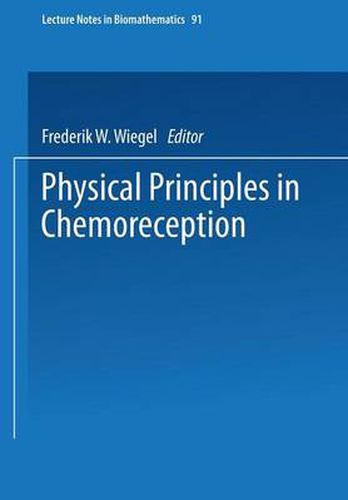
Is it not sheer foolishness to try to apply the methods of theoretical physics to biological structures? Physics flowered because it limited itself to the study of very simple systems; on the other hand, the essence of living things seems to have to do with the extreme intricacy of their structure. Is it a hopeless endeavour to attempt to bring the two together, or should one try nevertheless? Most of my colleagues in theoretical physics feel one should not waste one’s time and stick to the good old hydrogen atom , but some of them feel one should try anyhow. This minority point of view was shared by Bohr in the thirties, Schroedinger in the fourties, Delbruck in the fifties and sixties, PurceIl in the seventies, etc. The theory of chemoreception represents only a very small part of this immense scientific question. Its study was started by Delbriick and others in the fifties. I was introduced to these problems by Charles DeLisi, during a visit to the National Institutes of Health in the summer of 1980. During the following decade I had the pleasure to collaborate with George Bell, Byron Goldstein, Alan Perelson and others at the Los Alamos National Laboratory. We studied a wide variety of questions, some of them relevant to the theory of chemoreception. I am grateful to them, both for the pleasure which our joint research always gives to me, as weIl as for their friendship and hospitality.
$9.00 standard shipping within Australia
FREE standard shipping within Australia for orders over $100.00
Express & International shipping calculated at checkout
Stock availability can be subject to change without notice. We recommend calling the shop or contacting our online team to check availability of low stock items. Please see our Shopping Online page for more details.
This title is printed to order. This book may have been self-published. If so, we cannot guarantee the quality of the content. In the main most books will have gone through the editing process however some may not. We therefore suggest that you be aware of this before ordering this book. If in doubt check either the author or publisher’s details as we are unable to accept any returns unless they are faulty. Please contact us if you have any questions.
Is it not sheer foolishness to try to apply the methods of theoretical physics to biological structures? Physics flowered because it limited itself to the study of very simple systems; on the other hand, the essence of living things seems to have to do with the extreme intricacy of their structure. Is it a hopeless endeavour to attempt to bring the two together, or should one try nevertheless? Most of my colleagues in theoretical physics feel one should not waste one’s time and stick to the good old hydrogen atom , but some of them feel one should try anyhow. This minority point of view was shared by Bohr in the thirties, Schroedinger in the fourties, Delbruck in the fifties and sixties, PurceIl in the seventies, etc. The theory of chemoreception represents only a very small part of this immense scientific question. Its study was started by Delbriick and others in the fifties. I was introduced to these problems by Charles DeLisi, during a visit to the National Institutes of Health in the summer of 1980. During the following decade I had the pleasure to collaborate with George Bell, Byron Goldstein, Alan Perelson and others at the Los Alamos National Laboratory. We studied a wide variety of questions, some of them relevant to the theory of chemoreception. I am grateful to them, both for the pleasure which our joint research always gives to me, as weIl as for their friendship and hospitality.
Search our extensive online catalogue.
