Readings Newsletter
Become a Readings Member to make your shopping experience even easier.
Sign in or sign up for free!
You’re not far away from qualifying for FREE standard shipping within Australia
You’ve qualified for FREE standard shipping within Australia
The cart is loading…


This title is printed to order. This book may have been self-published. If so, we cannot guarantee the quality of the content. In the main most books will have gone through the editing process however some may not. We therefore suggest that you be aware of this before ordering this book. If in doubt check either the author or publisher’s details as we are unable to accept any returns unless they are faulty. Please contact us if you have any questions.
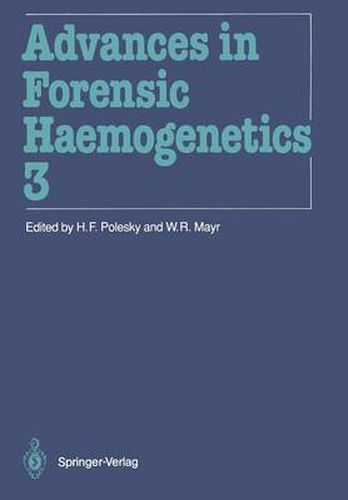
The third volume of Advances in Forensic Haemogenetics contains the th scientific contributions presented at the 13 Congress of the International Society for Forensic Haemogenetics, held on October 19-21, 1989 in New Orleans, USA. The conference was organized and chaired by Dr. Herbert Polesky from Minneapolis. He and the local organizing committee which consisted of our friends and colleagues (J. Soubrada, L.R.Bryant, Dale D.Dykes, Ch.Harrison, P.Newall and R. Walker) deserve the thanks of our Society for a very successful meeting. Herb Polesky has also contributed a great deal to the preparation of this book. The contributions to the conference covered all fields of forensic haemo genetics, but an outstanding highlight of this conference was the application ofDNA-polymorphisms to paternity and to the identification of stains. This included basic lectures on biostatistical approaches as well as on molecular biology and many new technical approaches to our general and special aims. Forensic haemogenetics has now merged into a new discipline without having lost its original identity. On behalf of the Executive Committee of our Society I would like to extend my thanks to the authors of the articles contained in this book and to Springer-Verlag for having made such a quick publication possible. The volume should give the reader a picture of the state of the art and a survey of the most recent developments in the field of forensic and general haemo genetics.
$9.00 standard shipping within Australia
FREE standard shipping within Australia for orders over $100.00
Express & International shipping calculated at checkout
Stock availability can be subject to change without notice. We recommend calling the shop or contacting our online team to check availability of low stock items. Please see our Shopping Online page for more details.
This title is printed to order. This book may have been self-published. If so, we cannot guarantee the quality of the content. In the main most books will have gone through the editing process however some may not. We therefore suggest that you be aware of this before ordering this book. If in doubt check either the author or publisher’s details as we are unable to accept any returns unless they are faulty. Please contact us if you have any questions.
The third volume of Advances in Forensic Haemogenetics contains the th scientific contributions presented at the 13 Congress of the International Society for Forensic Haemogenetics, held on October 19-21, 1989 in New Orleans, USA. The conference was organized and chaired by Dr. Herbert Polesky from Minneapolis. He and the local organizing committee which consisted of our friends and colleagues (J. Soubrada, L.R.Bryant, Dale D.Dykes, Ch.Harrison, P.Newall and R. Walker) deserve the thanks of our Society for a very successful meeting. Herb Polesky has also contributed a great deal to the preparation of this book. The contributions to the conference covered all fields of forensic haemo genetics, but an outstanding highlight of this conference was the application ofDNA-polymorphisms to paternity and to the identification of stains. This included basic lectures on biostatistical approaches as well as on molecular biology and many new technical approaches to our general and special aims. Forensic haemogenetics has now merged into a new discipline without having lost its original identity. On behalf of the Executive Committee of our Society I would like to extend my thanks to the authors of the articles contained in this book and to Springer-Verlag for having made such a quick publication possible. The volume should give the reader a picture of the state of the art and a survey of the most recent developments in the field of forensic and general haemo genetics.
Search our extensive online catalogue.
