Readings Newsletter
Become a Readings Member to make your shopping experience even easier.
Sign in or sign up for free!
You’re not far away from qualifying for FREE standard shipping within Australia
You’ve qualified for FREE standard shipping within Australia
The cart is loading…


This title is printed to order. This book may have been self-published. If so, we cannot guarantee the quality of the content. In the main most books will have gone through the editing process however some may not. We therefore suggest that you be aware of this before ordering this book. If in doubt check either the author or publisher’s details as we are unable to accept any returns unless they are faulty. Please contact us if you have any questions.
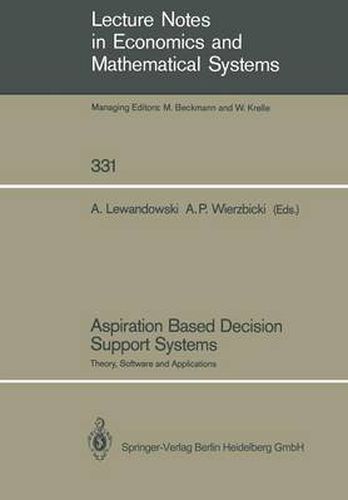
It is not easy to summarize -even in a volume -the results of a scientific study con ducted by circa 30 researchers, in four different research institutions, though cooperating between them and jointly with the International Institute for Applied Systems Analysis, but working part-time, sponsored not only by IIASA’s national currency funds, but also by several other research grants in Poland. The aims of this cooperative study were de fined broadly by its title Theory, Software and Testing Examples for Decision Support Systems. The focusing theme was the methodology of decision analysis and support related to the principle of reference point optimization (developed by the editors of this volume and called also variously: aspiration-led decision support, quasi-satisfying framework of rationality, DIDAS methodology etc. ). This focusing theme motivated extensive theoretical research - from basic methodological issues of decision analysis, through various results in mathematical programming (in the fields of large scale and stochastic optimization, nondifferentiable optimization, cooperative game theory) mo tivated and needed because of this theme, through methodological issues related to software development to issues resulting from testing and applications. We could not include in this volume all papers -theoretical, methodological, appiied, software manu als and documentation -written during this cooperative study.
$9.00 standard shipping within Australia
FREE standard shipping within Australia for orders over $100.00
Express & International shipping calculated at checkout
Stock availability can be subject to change without notice. We recommend calling the shop or contacting our online team to check availability of low stock items. Please see our Shopping Online page for more details.
This title is printed to order. This book may have been self-published. If so, we cannot guarantee the quality of the content. In the main most books will have gone through the editing process however some may not. We therefore suggest that you be aware of this before ordering this book. If in doubt check either the author or publisher’s details as we are unable to accept any returns unless they are faulty. Please contact us if you have any questions.
It is not easy to summarize -even in a volume -the results of a scientific study con ducted by circa 30 researchers, in four different research institutions, though cooperating between them and jointly with the International Institute for Applied Systems Analysis, but working part-time, sponsored not only by IIASA’s national currency funds, but also by several other research grants in Poland. The aims of this cooperative study were de fined broadly by its title Theory, Software and Testing Examples for Decision Support Systems. The focusing theme was the methodology of decision analysis and support related to the principle of reference point optimization (developed by the editors of this volume and called also variously: aspiration-led decision support, quasi-satisfying framework of rationality, DIDAS methodology etc. ). This focusing theme motivated extensive theoretical research - from basic methodological issues of decision analysis, through various results in mathematical programming (in the fields of large scale and stochastic optimization, nondifferentiable optimization, cooperative game theory) mo tivated and needed because of this theme, through methodological issues related to software development to issues resulting from testing and applications. We could not include in this volume all papers -theoretical, methodological, appiied, software manu als and documentation -written during this cooperative study.
Search our extensive online catalogue.
