Readings Newsletter
Become a Readings Member to make your shopping experience even easier.
Sign in or sign up for free!
You’re not far away from qualifying for FREE standard shipping within Australia
You’ve qualified for FREE standard shipping within Australia
The cart is loading…


This title is printed to order. This book may have been self-published. If so, we cannot guarantee the quality of the content. In the main most books will have gone through the editing process however some may not. We therefore suggest that you be aware of this before ordering this book. If in doubt check either the author or publisher’s details as we are unable to accept any returns unless they are faulty. Please contact us if you have any questions.
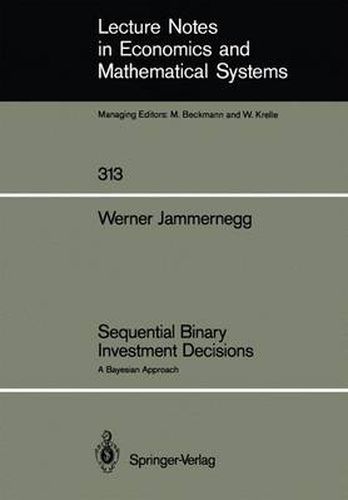
This book describes some models from the theory of investment which are mainly characterized by three features. Firstly, the decision-maker acts in a dynamic environment. Secondly, the distributions of the random variables are only incompletely known at the beginning of the planning process. This is termed as decision-making under conditions of uncer tainty. Thirdly, in large parts of the work we restrict the analysis to binary decision models. In a binary model, the decision-maker must choose one of two actions. For example, one decision means to undertake the invest *ment project in a planning period, whereas the other decision prescribes to postpone the project for at least one more period. The analysis of dynamic decision models under conditions of uncertainty is not a very common approach in economics. In this framework the op timal decisions are only obtained by the extensive use of methods from operations research and from statistics. It is the intention to narrow some of the existing gaps in the fields of investment and portfolio analysis in this respect. This is done by combining techniques that have been devel oped in investment theory and portfolio selection, in stochastic dynamic programming, and in Bayesian statistics. The latter field indicates the use of Bayes’ theorem for the revision of the probability distributions of the random variables over time.
$9.00 standard shipping within Australia
FREE standard shipping within Australia for orders over $100.00
Express & International shipping calculated at checkout
Stock availability can be subject to change without notice. We recommend calling the shop or contacting our online team to check availability of low stock items. Please see our Shopping Online page for more details.
This title is printed to order. This book may have been self-published. If so, we cannot guarantee the quality of the content. In the main most books will have gone through the editing process however some may not. We therefore suggest that you be aware of this before ordering this book. If in doubt check either the author or publisher’s details as we are unable to accept any returns unless they are faulty. Please contact us if you have any questions.
This book describes some models from the theory of investment which are mainly characterized by three features. Firstly, the decision-maker acts in a dynamic environment. Secondly, the distributions of the random variables are only incompletely known at the beginning of the planning process. This is termed as decision-making under conditions of uncer tainty. Thirdly, in large parts of the work we restrict the analysis to binary decision models. In a binary model, the decision-maker must choose one of two actions. For example, one decision means to undertake the invest *ment project in a planning period, whereas the other decision prescribes to postpone the project for at least one more period. The analysis of dynamic decision models under conditions of uncertainty is not a very common approach in economics. In this framework the op timal decisions are only obtained by the extensive use of methods from operations research and from statistics. It is the intention to narrow some of the existing gaps in the fields of investment and portfolio analysis in this respect. This is done by combining techniques that have been devel oped in investment theory and portfolio selection, in stochastic dynamic programming, and in Bayesian statistics. The latter field indicates the use of Bayes’ theorem for the revision of the probability distributions of the random variables over time.
Search our extensive online catalogue.
