Readings Newsletter
Become a Readings Member to make your shopping experience even easier.
Sign in or sign up for free!
You’re not far away from qualifying for FREE standard shipping within Australia
You’ve qualified for FREE standard shipping within Australia
The cart is loading…


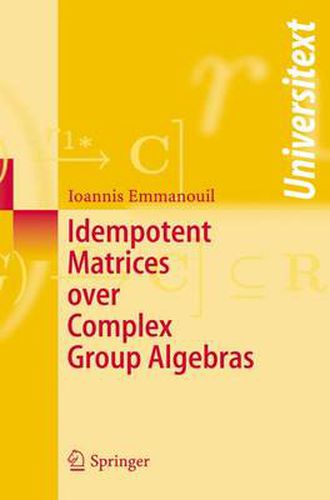
This title is printed to order. This book may have been self-published. If so, we cannot guarantee the quality of the content. In the main most books will have gone through the editing process however some may not. We therefore suggest that you be aware of this before ordering this book. If in doubt check either the author or publisher’s details as we are unable to accept any returns unless they are faulty. Please contact us if you have any questions.
The study of idempotent elements in group algebras (or, more generally, the study of classes in the K-theory of such algebras) originates from geometric and analytic considerations. For example, C.T.C. Wall [72] has shown that the problem of deciding whether a ?nitely dominated space with fundamental group? is homotopy equivalent to a ?nite CW-complex leads naturally to the study of a certain class in the reduced K-theoryK (Z?) of the group ringZ?. 0 As another example, consider a discrete groupG which acts freely, properly discontinuously, cocompactly and isometrically on a Riemannian manifold. Then, following A. Connes and H. Moscovici [16], the index of an invariant 0th-order elliptic pseudo-di?erential operator is de?ned as an element in the ? ? K -group of the reduced groupC -algebraCG. 0 r Theidempotentconjecture(alsoknownasthegeneralizedKadisonconjec- ? ? ture) asserts that the reduced groupC -algebraCG of a discrete torsion-free r groupG has no idempotents =0,1; this claim is known to be a consequence of a far-reaching conjecture of P. Baum and A. Connes [6]. Alternatively, one mayapproachtheidempotentconjectureasanassertionabouttheconnect- ness of a non-commutative space;ifG is a discrete torsion-free abelian group ? thenCG is the algebra of continuous complex-valued functions on the dual r
$9.00 standard shipping within Australia
FREE standard shipping within Australia for orders over $100.00
Express & International shipping calculated at checkout
Stock availability can be subject to change without notice. We recommend calling the shop or contacting our online team to check availability of low stock items. Please see our Shopping Online page for more details.
This title is printed to order. This book may have been self-published. If so, we cannot guarantee the quality of the content. In the main most books will have gone through the editing process however some may not. We therefore suggest that you be aware of this before ordering this book. If in doubt check either the author or publisher’s details as we are unable to accept any returns unless they are faulty. Please contact us if you have any questions.
The study of idempotent elements in group algebras (or, more generally, the study of classes in the K-theory of such algebras) originates from geometric and analytic considerations. For example, C.T.C. Wall [72] has shown that the problem of deciding whether a ?nitely dominated space with fundamental group? is homotopy equivalent to a ?nite CW-complex leads naturally to the study of a certain class in the reduced K-theoryK (Z?) of the group ringZ?. 0 As another example, consider a discrete groupG which acts freely, properly discontinuously, cocompactly and isometrically on a Riemannian manifold. Then, following A. Connes and H. Moscovici [16], the index of an invariant 0th-order elliptic pseudo-di?erential operator is de?ned as an element in the ? ? K -group of the reduced groupC -algebraCG. 0 r Theidempotentconjecture(alsoknownasthegeneralizedKadisonconjec- ? ? ture) asserts that the reduced groupC -algebraCG of a discrete torsion-free r groupG has no idempotents =0,1; this claim is known to be a consequence of a far-reaching conjecture of P. Baum and A. Connes [6]. Alternatively, one mayapproachtheidempotentconjectureasanassertionabouttheconnect- ness of a non-commutative space;ifG is a discrete torsion-free abelian group ? thenCG is the algebra of continuous complex-valued functions on the dual r
Search our extensive online catalogue.
