Readings Newsletter
Become a Readings Member to make your shopping experience even easier.
Sign in or sign up for free!
You’re not far away from qualifying for FREE standard shipping within Australia
You’ve qualified for FREE standard shipping within Australia
The cart is loading…


This title is printed to order. This book may have been self-published. If so, we cannot guarantee the quality of the content. In the main most books will have gone through the editing process however some may not. We therefore suggest that you be aware of this before ordering this book. If in doubt check either the author or publisher’s details as we are unable to accept any returns unless they are faulty. Please contact us if you have any questions.
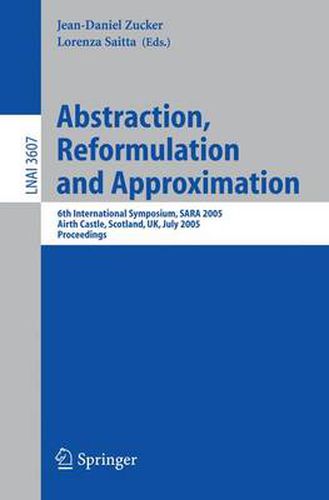
This volume contains the proceedings of the 6th Symposium on Abstraction, Reformulation and Approximation (SARA 2005). The symposium was held at Airth Castle, Scotland, UK, from July 26th to 29th, 2005, just prior to the IJCAI 2005 conference in Edinburgh. Previous SARA symposia took place at JacksonHole in Wyoming, USA (1994),Ville d'Estrel in Qubec, Canada (1995), Asilomar in California, USA (1998), Horseshoe Bay, Texas, USA (2000), and Kananaskis, Alberta, Canada (2002). This was then the ?rst time that the s- posium was held in Europe. Continuing the tradition started with SARA 2000, the proceedings have been published in the LNAI series of Springer. Abstractions, reformulations and approximations (AR&A) have found app- cationsin avarietyofdisciplines andproblems,including constraintsatisfaction, design, diagnosis, machine learning, planning, qualitative reasoning, scheduling, resource allocation and theorem proving, but are also deeply rooted in philo- phy and cognitive science. The papers in this volume capture a cross-section of the various facets of the ?eld and of its applications. One of the primary uses of AR&A is oriented to overcome computational intractability. AR&A techniques, however, have also proved useful for knowledge acquisition, explanation and other applications, as papers in this volume also illustrate.
$9.00 standard shipping within Australia
FREE standard shipping within Australia for orders over $100.00
Express & International shipping calculated at checkout
Stock availability can be subject to change without notice. We recommend calling the shop or contacting our online team to check availability of low stock items. Please see our Shopping Online page for more details.
This title is printed to order. This book may have been self-published. If so, we cannot guarantee the quality of the content. In the main most books will have gone through the editing process however some may not. We therefore suggest that you be aware of this before ordering this book. If in doubt check either the author or publisher’s details as we are unable to accept any returns unless they are faulty. Please contact us if you have any questions.
This volume contains the proceedings of the 6th Symposium on Abstraction, Reformulation and Approximation (SARA 2005). The symposium was held at Airth Castle, Scotland, UK, from July 26th to 29th, 2005, just prior to the IJCAI 2005 conference in Edinburgh. Previous SARA symposia took place at JacksonHole in Wyoming, USA (1994),Ville d'Estrel in Qubec, Canada (1995), Asilomar in California, USA (1998), Horseshoe Bay, Texas, USA (2000), and Kananaskis, Alberta, Canada (2002). This was then the ?rst time that the s- posium was held in Europe. Continuing the tradition started with SARA 2000, the proceedings have been published in the LNAI series of Springer. Abstractions, reformulations and approximations (AR&A) have found app- cationsin avarietyofdisciplines andproblems,including constraintsatisfaction, design, diagnosis, machine learning, planning, qualitative reasoning, scheduling, resource allocation and theorem proving, but are also deeply rooted in philo- phy and cognitive science. The papers in this volume capture a cross-section of the various facets of the ?eld and of its applications. One of the primary uses of AR&A is oriented to overcome computational intractability. AR&A techniques, however, have also proved useful for knowledge acquisition, explanation and other applications, as papers in this volume also illustrate.
Search our extensive online catalogue.
