Readings Newsletter
Become a Readings Member to make your shopping experience even easier.
Sign in or sign up for free!
You’re not far away from qualifying for FREE standard shipping within Australia
You’ve qualified for FREE standard shipping within Australia
The cart is loading…


This title is printed to order. This book may have been self-published. If so, we cannot guarantee the quality of the content. In the main most books will have gone through the editing process however some may not. We therefore suggest that you be aware of this before ordering this book. If in doubt check either the author or publisher’s details as we are unable to accept any returns unless they are faulty. Please contact us if you have any questions.
The aim of contextual logic is to provide a formal theory of elementary logic, which is based on the doctrines of concepts, judgements, and conclusions. Concepts are mathematized using Formal Concept Analysis (FCA), while an approach to the formalization of judgements and conclusions is conceptual graphs, based on Peirce’s existential graphs. Combining FCA and a mathematization of conceptual graphs yields so-called concept graphs, which offer a formal and diagrammatic theory of elementary logic.
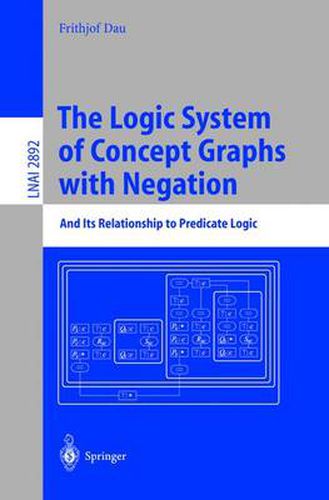
Expressing negation in contextual logic is a difficult task. Based on the author’s dissertation, this book shows how negation on the level of judgements can be implemented. To do so, cuts (syntactical devices used to express negation) are added to concept graphs. As we can express relations between objects, conjunction and negation in judgements, and existential quantification, the author demonstrates that concept graphs with cuts have the expressive power of first-order predicate logic. While doing so, the author distinguishes between syntax and semantics, and provides a sound and complete calculus for concept graphs with cuts. The author’s treatment is mathematically thorough and consistent, and the book gives the necessary background on existential and conceptual graphs.
$9.00 standard shipping within Australia
FREE standard shipping within Australia for orders over $100.00
Express & International shipping calculated at checkout
Stock availability can be subject to change without notice. We recommend calling the shop or contacting our online team to check availability of low stock items. Please see our Shopping Online page for more details.
This title is printed to order. This book may have been self-published. If so, we cannot guarantee the quality of the content. In the main most books will have gone through the editing process however some may not. We therefore suggest that you be aware of this before ordering this book. If in doubt check either the author or publisher’s details as we are unable to accept any returns unless they are faulty. Please contact us if you have any questions.
The aim of contextual logic is to provide a formal theory of elementary logic, which is based on the doctrines of concepts, judgements, and conclusions. Concepts are mathematized using Formal Concept Analysis (FCA), while an approach to the formalization of judgements and conclusions is conceptual graphs, based on Peirce’s existential graphs. Combining FCA and a mathematization of conceptual graphs yields so-called concept graphs, which offer a formal and diagrammatic theory of elementary logic.
Expressing negation in contextual logic is a difficult task. Based on the author’s dissertation, this book shows how negation on the level of judgements can be implemented. To do so, cuts (syntactical devices used to express negation) are added to concept graphs. As we can express relations between objects, conjunction and negation in judgements, and existential quantification, the author demonstrates that concept graphs with cuts have the expressive power of first-order predicate logic. While doing so, the author distinguishes between syntax and semantics, and provides a sound and complete calculus for concept graphs with cuts. The author’s treatment is mathematically thorough and consistent, and the book gives the necessary background on existential and conceptual graphs.
Search our extensive online catalogue.
