Readings Newsletter
Become a Readings Member to make your shopping experience even easier.
Sign in or sign up for free!
You’re not far away from qualifying for FREE standard shipping within Australia
You’ve qualified for FREE standard shipping within Australia
The cart is loading…


This title is printed to order. This book may have been self-published. If so, we cannot guarantee the quality of the content. In the main most books will have gone through the editing process however some may not. We therefore suggest that you be aware of this before ordering this book. If in doubt check either the author or publisher’s details as we are unable to accept any returns unless they are faulty. Please contact us if you have any questions.
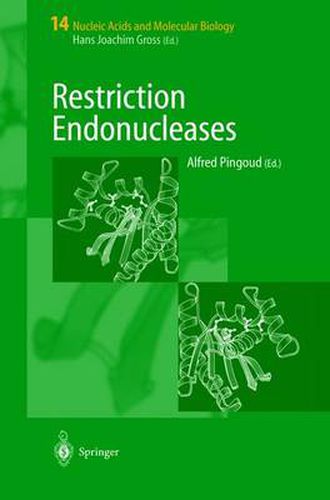
Restriction enzymes are highly specific nucleases which occur ubiquitously among prokaryotic organisms, where they serve to protect bacterial cells against foreign DNA. Many different types of restriction enzymes are known, among them multi-subunit enzymes which depend on ATP or GTP hydrolysis for target site location. The best known representatives, the orthodox type II restriction endonucleases, are homodimers which recognize palindromic sequences, 4 to 8 base pairs in length, and cleave the DNA within or immediately adjacent to the recognition site. In addition to their important biological role (up to 10 % of the genomes of prokaryotic organisms code for restriction/modification systems!), they are among the most important enzymes used for the analysis and recombination of DNA. In addition, they are model systems for the study of protein-nucleic acids interactions and, because of their ubiquitous occurence, also for the understanding of the mechanisms of evolution.
$9.00 standard shipping within Australia
FREE standard shipping within Australia for orders over $100.00
Express & International shipping calculated at checkout
Stock availability can be subject to change without notice. We recommend calling the shop or contacting our online team to check availability of low stock items. Please see our Shopping Online page for more details.
This title is printed to order. This book may have been self-published. If so, we cannot guarantee the quality of the content. In the main most books will have gone through the editing process however some may not. We therefore suggest that you be aware of this before ordering this book. If in doubt check either the author or publisher’s details as we are unable to accept any returns unless they are faulty. Please contact us if you have any questions.
Restriction enzymes are highly specific nucleases which occur ubiquitously among prokaryotic organisms, where they serve to protect bacterial cells against foreign DNA. Many different types of restriction enzymes are known, among them multi-subunit enzymes which depend on ATP or GTP hydrolysis for target site location. The best known representatives, the orthodox type II restriction endonucleases, are homodimers which recognize palindromic sequences, 4 to 8 base pairs in length, and cleave the DNA within or immediately adjacent to the recognition site. In addition to their important biological role (up to 10 % of the genomes of prokaryotic organisms code for restriction/modification systems!), they are among the most important enzymes used for the analysis and recombination of DNA. In addition, they are model systems for the study of protein-nucleic acids interactions and, because of their ubiquitous occurence, also for the understanding of the mechanisms of evolution.
Search our extensive online catalogue.
