Readings Newsletter
Become a Readings Member to make your shopping experience even easier.
Sign in or sign up for free!
You’re not far away from qualifying for FREE standard shipping within Australia
You’ve qualified for FREE standard shipping within Australia
The cart is loading…


This title is printed to order. This book may have been self-published. If so, we cannot guarantee the quality of the content. In the main most books will have gone through the editing process however some may not. We therefore suggest that you be aware of this before ordering this book. If in doubt check either the author or publisher’s details as we are unable to accept any returns unless they are faulty. Please contact us if you have any questions.
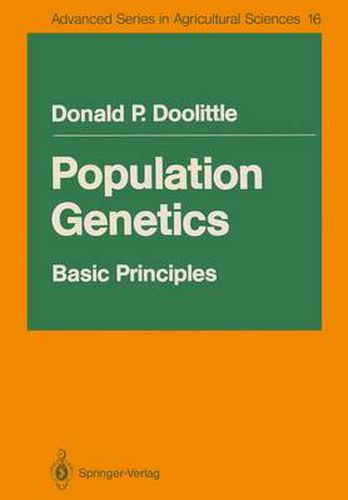
I have for a number of years taught a course in population genetics for students interested in plant and animal breeding. The objective of the course has been to lay a foundation in population genetics for the concepts of quantitative genetics which are introduced in the last third of the course. I have not been able to find an appropriate text for this purpose. For a quarter of a century, Falconer’s Introduction to Quantitative Genetics has been the standard, and excellent, text in that subject. For my purposes, however, this text is not sufficiently detailed in the population genetics basis for quantitative theory. A number of good texts in population genetics are available, of which Li’s First Course in Population Genetics is didactically the best. But these texts are directed toward the genetics of natural populations, rather than domestic populations, breeding under human control. They also tend to treat quantitative genetics gingerly, if at all. I have therefore developed the present text from my teaching notes. The chapters of this book are labeled Lectures . Each is intended to correspond approximately to the amount of material which can be covered in a 50-minute lecture. Divisions are, of course, dictated by the natural divisions of the subject matter, and the lectures are therefore not of uniform length. Nevertheless, in so far as possible, an attempt has been made to make the average length a lecture’s worth.
$9.00 standard shipping within Australia
FREE standard shipping within Australia for orders over $100.00
Express & International shipping calculated at checkout
Stock availability can be subject to change without notice. We recommend calling the shop or contacting our online team to check availability of low stock items. Please see our Shopping Online page for more details.
This title is printed to order. This book may have been self-published. If so, we cannot guarantee the quality of the content. In the main most books will have gone through the editing process however some may not. We therefore suggest that you be aware of this before ordering this book. If in doubt check either the author or publisher’s details as we are unable to accept any returns unless they are faulty. Please contact us if you have any questions.
I have for a number of years taught a course in population genetics for students interested in plant and animal breeding. The objective of the course has been to lay a foundation in population genetics for the concepts of quantitative genetics which are introduced in the last third of the course. I have not been able to find an appropriate text for this purpose. For a quarter of a century, Falconer’s Introduction to Quantitative Genetics has been the standard, and excellent, text in that subject. For my purposes, however, this text is not sufficiently detailed in the population genetics basis for quantitative theory. A number of good texts in population genetics are available, of which Li’s First Course in Population Genetics is didactically the best. But these texts are directed toward the genetics of natural populations, rather than domestic populations, breeding under human control. They also tend to treat quantitative genetics gingerly, if at all. I have therefore developed the present text from my teaching notes. The chapters of this book are labeled Lectures . Each is intended to correspond approximately to the amount of material which can be covered in a 50-minute lecture. Divisions are, of course, dictated by the natural divisions of the subject matter, and the lectures are therefore not of uniform length. Nevertheless, in so far as possible, an attempt has been made to make the average length a lecture’s worth.
Search our extensive online catalogue.
