Readings Newsletter
Become a Readings Member to make your shopping experience even easier.
Sign in or sign up for free!
You’re not far away from qualifying for FREE standard shipping within Australia
You’ve qualified for FREE standard shipping within Australia
The cart is loading…


This title is printed to order. This book may have been self-published. If so, we cannot guarantee the quality of the content. In the main most books will have gone through the editing process however some may not. We therefore suggest that you be aware of this before ordering this book. If in doubt check either the author or publisher’s details as we are unable to accept any returns unless they are faulty. Please contact us if you have any questions.
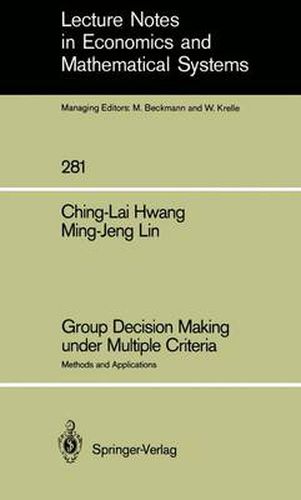
This monograph is intended for an advanced undergraduate or graduate course of engineering and management science. as well as for persons in business. industry. military or in any field. who want an introductory and a capsule look into the methods of group decision making under multiple criteria. This is a sequel to our previous works entitled Multiple Objective Decision Making–Methods and Applications (No. 164 of the Lecture Notes). and Multiple Attribute Decision Making–Methods and Applications (No. 186 of the Lecture Notes). Moving from a single decision maker (the consideration of Lecture Notes 164 and 186) to a multiple decision maker setting introduces a great deal of complexity into the analysis. The problem is no longer the selection of the most preferred alternative among the nondominated solutions according to one individual’s (single decision maker’s) preference structure. The analysis is extended to account for the conflicts among different interest groups who have different objectives. goals. and so forth. Group decision making under multiple criteria includes such diverse and interconnected fields as preference analysis. utility theory. social choice theory. committee decision theory. theory of voting. game theory. expert evaluation analysis. aggregation of qualitative factors. economic equilibrium theory. etc; these are simplified and systematically classified for beginners. This work is to provide readers with a capsule look into the existing methods. their characteristics. and applicability in the complexity of group decision making.
$9.00 standard shipping within Australia
FREE standard shipping within Australia for orders over $100.00
Express & International shipping calculated at checkout
Stock availability can be subject to change without notice. We recommend calling the shop or contacting our online team to check availability of low stock items. Please see our Shopping Online page for more details.
This title is printed to order. This book may have been self-published. If so, we cannot guarantee the quality of the content. In the main most books will have gone through the editing process however some may not. We therefore suggest that you be aware of this before ordering this book. If in doubt check either the author or publisher’s details as we are unable to accept any returns unless they are faulty. Please contact us if you have any questions.
This monograph is intended for an advanced undergraduate or graduate course of engineering and management science. as well as for persons in business. industry. military or in any field. who want an introductory and a capsule look into the methods of group decision making under multiple criteria. This is a sequel to our previous works entitled Multiple Objective Decision Making–Methods and Applications (No. 164 of the Lecture Notes). and Multiple Attribute Decision Making–Methods and Applications (No. 186 of the Lecture Notes). Moving from a single decision maker (the consideration of Lecture Notes 164 and 186) to a multiple decision maker setting introduces a great deal of complexity into the analysis. The problem is no longer the selection of the most preferred alternative among the nondominated solutions according to one individual’s (single decision maker’s) preference structure. The analysis is extended to account for the conflicts among different interest groups who have different objectives. goals. and so forth. Group decision making under multiple criteria includes such diverse and interconnected fields as preference analysis. utility theory. social choice theory. committee decision theory. theory of voting. game theory. expert evaluation analysis. aggregation of qualitative factors. economic equilibrium theory. etc; these are simplified and systematically classified for beginners. This work is to provide readers with a capsule look into the existing methods. their characteristics. and applicability in the complexity of group decision making.
Search our extensive online catalogue.
