Readings Newsletter
Become a Readings Member to make your shopping experience even easier.
Sign in or sign up for free!
You’re not far away from qualifying for FREE standard shipping within Australia
You’ve qualified for FREE standard shipping within Australia
The cart is loading…


This title is printed to order. This book may have been self-published. If so, we cannot guarantee the quality of the content. In the main most books will have gone through the editing process however some may not. We therefore suggest that you be aware of this before ordering this book. If in doubt check either the author or publisher’s details as we are unable to accept any returns unless they are faulty. Please contact us if you have any questions.
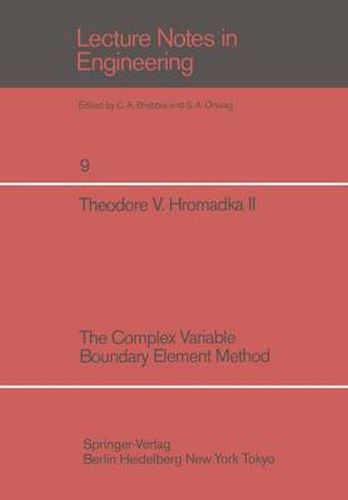
The Complex Variable Boundary Element Method or CVBEM is a generalization of the Cauchy integral formula into a boundary integral equation method or BIEM. This generalization allows an immediate and extremely valuable transfer of the modeling techniques used in real variable boundary integral equation methods (or boundary element methods) to the CVBEM. Consequently, modeling techniques for dissimilar materials, anisotropic materials, and time advancement, can be directly applied without modification to the CVBEM. An extremely useful feature offered by the CVBEM is that the pro duced approximation functions are analytic within the domain enclosed by the problem boundary and, therefore, exactly satisfy the two-dimensional Laplace equation throughout the problem domain. Another feature of the CVBEM is the integrations of the boundary integrals along each boundary element are solved exactly without the need for numerical integration. Additionally, the error analysis of the CVBEM approximation functions is workable by the easy-to-understand concept of relative error. A sophistication of the relative error analysis is the generation of an approximative boundary upon which the CVBEM approximation function exactly solves the boundary conditions of the boundary value problem’ (of the Laplace equation), and the goodness of approximation is easily seen as a closeness-of-fit between the approximative and true problem boundaries.
$9.00 standard shipping within Australia
FREE standard shipping within Australia for orders over $100.00
Express & International shipping calculated at checkout
Stock availability can be subject to change without notice. We recommend calling the shop or contacting our online team to check availability of low stock items. Please see our Shopping Online page for more details.
This title is printed to order. This book may have been self-published. If so, we cannot guarantee the quality of the content. In the main most books will have gone through the editing process however some may not. We therefore suggest that you be aware of this before ordering this book. If in doubt check either the author or publisher’s details as we are unable to accept any returns unless they are faulty. Please contact us if you have any questions.
The Complex Variable Boundary Element Method or CVBEM is a generalization of the Cauchy integral formula into a boundary integral equation method or BIEM. This generalization allows an immediate and extremely valuable transfer of the modeling techniques used in real variable boundary integral equation methods (or boundary element methods) to the CVBEM. Consequently, modeling techniques for dissimilar materials, anisotropic materials, and time advancement, can be directly applied without modification to the CVBEM. An extremely useful feature offered by the CVBEM is that the pro duced approximation functions are analytic within the domain enclosed by the problem boundary and, therefore, exactly satisfy the two-dimensional Laplace equation throughout the problem domain. Another feature of the CVBEM is the integrations of the boundary integrals along each boundary element are solved exactly without the need for numerical integration. Additionally, the error analysis of the CVBEM approximation functions is workable by the easy-to-understand concept of relative error. A sophistication of the relative error analysis is the generation of an approximative boundary upon which the CVBEM approximation function exactly solves the boundary conditions of the boundary value problem’ (of the Laplace equation), and the goodness of approximation is easily seen as a closeness-of-fit between the approximative and true problem boundaries.
Search our extensive online catalogue.
