Readings Newsletter
Become a Readings Member to make your shopping experience even easier.
Sign in or sign up for free!
You’re not far away from qualifying for FREE standard shipping within Australia
You’ve qualified for FREE standard shipping within Australia
The cart is loading…


This title is printed to order. This book may have been self-published. If so, we cannot guarantee the quality of the content. In the main most books will have gone through the editing process however some may not. We therefore suggest that you be aware of this before ordering this book. If in doubt check either the author or publisher’s details as we are unable to accept any returns unless they are faulty. Please contact us if you have any questions.
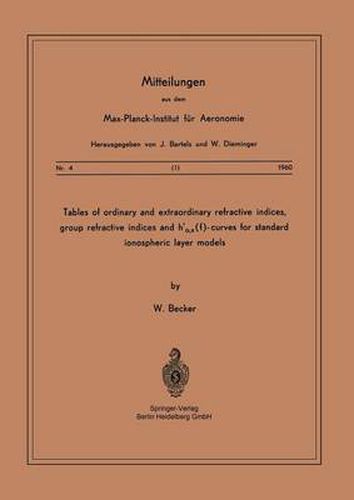
The N(h)-Working Party, a Group in Commission III of URS! (URS! Information Bulletin No. 112, p. 12) suggested these calculations of ordinary and extraordinary refractive indices n , vertical group refractive indices c/U , and virtual o,x o,x 1 heights h (f), for an Epstein, cosine and parabolic layer model. c ist the free 0 X 1 space velocity of light . U and U denote vertical ordinary and extraordinary 0 X group velocities. The data are intended to facilitate real height (h) computations from 1 1 observed, h (f)-traces. Especially the h (f)-data are intended also to allow o,x o,x for tests of existing reduction methods. For ionization minimum investigations an additional set of tables is presented. These tables represent the virtual paths 1 6 h (f) of sounding pulses which penetrate an ionospheric layer of parabolic o,x 1 shape; they can be used together with the abovementioned standard h (f)-curves o,x 1 to give ordinary and extraordinary h (f)-traces for any combination of a lower O, X parabolic layer and an upper Epstein, cosine or parabolic electron density distribution. Ordinary group refractive index tables have already been published by D. H. SHINN [1] 1 and by Vv. BECKER [2] * Their value s of cp , the angle of inclination of the earth s magnetic field, are slightly different from those used here. These tables may be used 1 as additional sets for interpolation purposes. D. H.
$9.00 standard shipping within Australia
FREE standard shipping within Australia for orders over $100.00
Express & International shipping calculated at checkout
Stock availability can be subject to change without notice. We recommend calling the shop or contacting our online team to check availability of low stock items. Please see our Shopping Online page for more details.
This title is printed to order. This book may have been self-published. If so, we cannot guarantee the quality of the content. In the main most books will have gone through the editing process however some may not. We therefore suggest that you be aware of this before ordering this book. If in doubt check either the author or publisher’s details as we are unable to accept any returns unless they are faulty. Please contact us if you have any questions.
The N(h)-Working Party, a Group in Commission III of URS! (URS! Information Bulletin No. 112, p. 12) suggested these calculations of ordinary and extraordinary refractive indices n , vertical group refractive indices c/U , and virtual o,x o,x 1 heights h (f), for an Epstein, cosine and parabolic layer model. c ist the free 0 X 1 space velocity of light . U and U denote vertical ordinary and extraordinary 0 X group velocities. The data are intended to facilitate real height (h) computations from 1 1 observed, h (f)-traces. Especially the h (f)-data are intended also to allow o,x o,x for tests of existing reduction methods. For ionization minimum investigations an additional set of tables is presented. These tables represent the virtual paths 1 6 h (f) of sounding pulses which penetrate an ionospheric layer of parabolic o,x 1 shape; they can be used together with the abovementioned standard h (f)-curves o,x 1 to give ordinary and extraordinary h (f)-traces for any combination of a lower O, X parabolic layer and an upper Epstein, cosine or parabolic electron density distribution. Ordinary group refractive index tables have already been published by D. H. SHINN [1] 1 and by Vv. BECKER [2] * Their value s of cp , the angle of inclination of the earth s magnetic field, are slightly different from those used here. These tables may be used 1 as additional sets for interpolation purposes. D. H.
Search our extensive online catalogue.
