Readings Newsletter
Become a Readings Member to make your shopping experience even easier.
Sign in or sign up for free!
You’re not far away from qualifying for FREE standard shipping within Australia
You’ve qualified for FREE standard shipping within Australia
The cart is loading…


This title is printed to order. This book may have been self-published. If so, we cannot guarantee the quality of the content. In the main most books will have gone through the editing process however some may not. We therefore suggest that you be aware of this before ordering this book. If in doubt check either the author or publisher’s details as we are unable to accept any returns unless they are faulty. Please contact us if you have any questions.
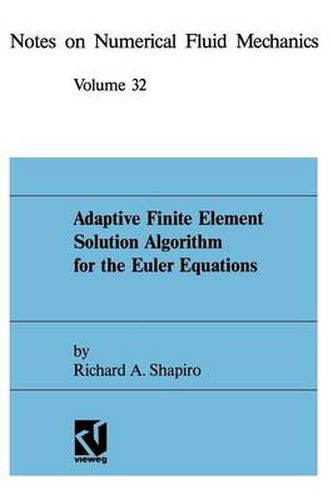
This monograph is the result of my PhD thesis work in Computational Fluid Dynamics at the Massachusettes Institute of Technology under the supervision of Professor Earll Murman. A new finite element al gorithm is presented for solving the steady Euler equations describing the flow of an inviscid, compressible, ideal gas. This algorithm uses a finite element spatial discretization coupled with a Runge-Kutta time integration to relax to steady state. It is shown that other algorithms, such as finite difference and finite volume methods, can be derived using finite element principles. A higher-order biquadratic approximation is introduced. Several test problems are computed to verify the algorithms. Adaptive gridding in two and three dimensions using quadrilateral and hexahedral elements is developed and verified. Adaptation is shown to provide CPU savings of a factor of 2 to 16, and biquadratic elements are shown to provide potential savings of a factor of 2 to 6. An analysis of the dispersive properties of several discretization methods for the Euler equations is presented, and results allowing the prediction of dispersive errors are obtained. The adaptive algorithm is applied to the solution of several flows in scramjet inlets in two and three dimensions, demonstrat ing some of the varied physics associated with these flows. Some issues in the design and implementation of adaptive finite element algorithms on vector and parallel computers are discussed.
$9.00 standard shipping within Australia
FREE standard shipping within Australia for orders over $100.00
Express & International shipping calculated at checkout
Stock availability can be subject to change without notice. We recommend calling the shop or contacting our online team to check availability of low stock items. Please see our Shopping Online page for more details.
This title is printed to order. This book may have been self-published. If so, we cannot guarantee the quality of the content. In the main most books will have gone through the editing process however some may not. We therefore suggest that you be aware of this before ordering this book. If in doubt check either the author or publisher’s details as we are unable to accept any returns unless they are faulty. Please contact us if you have any questions.
This monograph is the result of my PhD thesis work in Computational Fluid Dynamics at the Massachusettes Institute of Technology under the supervision of Professor Earll Murman. A new finite element al gorithm is presented for solving the steady Euler equations describing the flow of an inviscid, compressible, ideal gas. This algorithm uses a finite element spatial discretization coupled with a Runge-Kutta time integration to relax to steady state. It is shown that other algorithms, such as finite difference and finite volume methods, can be derived using finite element principles. A higher-order biquadratic approximation is introduced. Several test problems are computed to verify the algorithms. Adaptive gridding in two and three dimensions using quadrilateral and hexahedral elements is developed and verified. Adaptation is shown to provide CPU savings of a factor of 2 to 16, and biquadratic elements are shown to provide potential savings of a factor of 2 to 6. An analysis of the dispersive properties of several discretization methods for the Euler equations is presented, and results allowing the prediction of dispersive errors are obtained. The adaptive algorithm is applied to the solution of several flows in scramjet inlets in two and three dimensions, demonstrat ing some of the varied physics associated with these flows. Some issues in the design and implementation of adaptive finite element algorithms on vector and parallel computers are discussed.
Search our extensive online catalogue.
