Readings Newsletter
Become a Readings Member to make your shopping experience even easier.
Sign in or sign up for free!
You’re not far away from qualifying for FREE standard shipping within Australia
You’ve qualified for FREE standard shipping within Australia
The cart is loading…


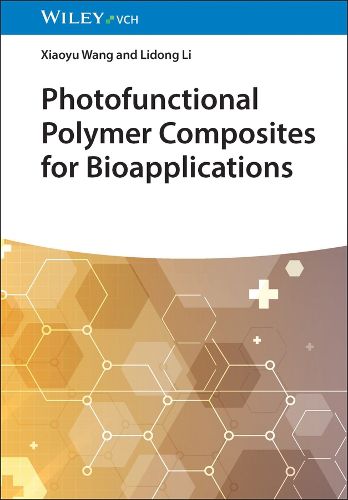
Explores photofunctional polymer composites for cutting-edge biomedical applications and innovations
The rapid evolution of materials science has positioned photofunctional polymer composites as a central focus in advancing biomedical technologies. These materials, with their tunable light-responsive properties, play a pivotal role in enabling breakthroughs in bioimaging, cancer therapy, and phototherapy. However, while fundamental research in this field has progressed considerably, translating these innovations into practical biomedical products continues to present significant challenges.
Photofunctional Polymer Composites for Bioapplications systematically covers the structures, properties, and applications of polymer composites designed for biomedical use. Featuring clear organization with chapters progressing from foundational principles to advanced applications, the book begins with an overview of classifications and biomedical applications of photofunctional polymer composites before progressing to their structures, photophysical and chemical properties, and construction strategies. The central chapters focus on fibers, films,
nanocomposites, and hydrogels, each discussing design, synthesis, and biomedical function. The final chapter offers a forward-looking perspective on the field, stressing interdisciplinary
collaboration as a pathway to practical implementation.
Balancing theory, methodology, and application, Photofunctional Polymer Composites for Bioapplications:
Covers an extensive range of polymer composite types, including nanomaterials, fibers, films, and hydrogels Provides in-depth discussion of charge transport, energy conversion, and signal transduction in composite systems Provides insights into how multi-component strategies and interface engineering may overcome current limitations Explores approaches that integrate chemistry, physics, biology, and engineering Includes detailed examination of biosafety considerations critical to biomedical applications
An authoritative reference for advancing both research and translational development, Photofunctional Polymer Composites for Bioapplications is designed for graduate-level students, researchers, and professionals in polymer chemistry, materials science, and biomedical engineering. It is well-suited for courses such as Advanced Biomaterials, Polymer Science for Biomedical Applications, and Nanomaterials in Medicine within graduate and doctoral programs in chemistry, materials science, and bioengineering.
$9.00 standard shipping within Australia
FREE standard shipping within Australia for orders over $100.00
Express & International shipping calculated at checkout
Stock availability can be subject to change without notice. We recommend calling the shop or contacting our online team to check availability of low stock items. Please see our Shopping Online page for more details.
Explores photofunctional polymer composites for cutting-edge biomedical applications and innovations
The rapid evolution of materials science has positioned photofunctional polymer composites as a central focus in advancing biomedical technologies. These materials, with their tunable light-responsive properties, play a pivotal role in enabling breakthroughs in bioimaging, cancer therapy, and phototherapy. However, while fundamental research in this field has progressed considerably, translating these innovations into practical biomedical products continues to present significant challenges.
Photofunctional Polymer Composites for Bioapplications systematically covers the structures, properties, and applications of polymer composites designed for biomedical use. Featuring clear organization with chapters progressing from foundational principles to advanced applications, the book begins with an overview of classifications and biomedical applications of photofunctional polymer composites before progressing to their structures, photophysical and chemical properties, and construction strategies. The central chapters focus on fibers, films,
nanocomposites, and hydrogels, each discussing design, synthesis, and biomedical function. The final chapter offers a forward-looking perspective on the field, stressing interdisciplinary
collaboration as a pathway to practical implementation.
Balancing theory, methodology, and application, Photofunctional Polymer Composites for Bioapplications:
Covers an extensive range of polymer composite types, including nanomaterials, fibers, films, and hydrogels Provides in-depth discussion of charge transport, energy conversion, and signal transduction in composite systems Provides insights into how multi-component strategies and interface engineering may overcome current limitations Explores approaches that integrate chemistry, physics, biology, and engineering Includes detailed examination of biosafety considerations critical to biomedical applications
An authoritative reference for advancing both research and translational development, Photofunctional Polymer Composites for Bioapplications is designed for graduate-level students, researchers, and professionals in polymer chemistry, materials science, and biomedical engineering. It is well-suited for courses such as Advanced Biomaterials, Polymer Science for Biomedical Applications, and Nanomaterials in Medicine within graduate and doctoral programs in chemistry, materials science, and bioengineering.
Search our extensive online catalogue.
