Readings Newsletter
Become a Readings Member to make your shopping experience even easier.
Sign in or sign up for free!
You’re not far away from qualifying for FREE standard shipping within Australia
You’ve qualified for FREE standard shipping within Australia
The cart is loading…


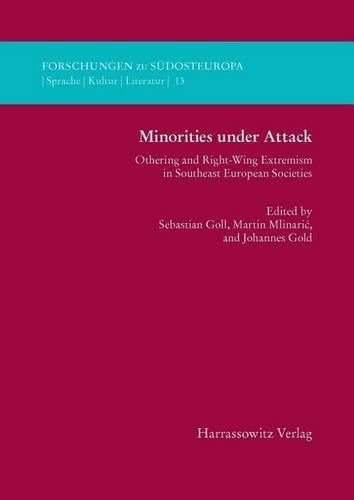
In the media, Southeastern Europe (SEE) is repeatedly portrayed as an area characterized by the exclusion of the Other. There is no doubt that xenophobia, racism, homophobia, anti-Semitism, and anti-Ziganism are deeply rooted within every European society, as is evident in the rise of hostile atmospheres towards Muslims in Denmark, Germany, and Sweden. Recurrent debates in Germany on so-called poverty- and social welfare-migrants from Bulgaria, Kosovo, and Romania, as well as anti-Islam movements like Patriotic Europeans against Islamization of the Occident (PEGIDA) are illustrating examples. Focusing on Southeastern Europe, this volume will make a nuanced contribution to these ongoing debates. Volume contributions are composed as empirical case studies on diverse forms of othering in different national contexts and settings of SEE and bare actual insights for further comparisons; some of them also seek to compare or analyze transnational aspects. In methodological terms, these contributions take a multilayer perspective addressing a variety of different academic schools and approaches including historiographic perspectives, remembrance history, poststructuralist discourse analysis, intersectional feminist and queer research, network analysis, studies on social movements, quantitative approaches, societal comparison, and anthropology. The editors managed to gather a broad variety of contributors from different disciplines both from the region of Southeastern Europe and Germany. Therefore, this volume is a multi-perspective contribution to answer the question on manifestations of othering in SEE. Especially in the light of the refugee crisis, the texts presented in this volume are relevant for the whole of Europe.
$9.00 standard shipping within Australia
FREE standard shipping within Australia for orders over $100.00
Express & International shipping calculated at checkout
Stock availability can be subject to change without notice. We recommend calling the shop or contacting our online team to check availability of low stock items. Please see our Shopping Online page for more details.
In the media, Southeastern Europe (SEE) is repeatedly portrayed as an area characterized by the exclusion of the Other. There is no doubt that xenophobia, racism, homophobia, anti-Semitism, and anti-Ziganism are deeply rooted within every European society, as is evident in the rise of hostile atmospheres towards Muslims in Denmark, Germany, and Sweden. Recurrent debates in Germany on so-called poverty- and social welfare-migrants from Bulgaria, Kosovo, and Romania, as well as anti-Islam movements like Patriotic Europeans against Islamization of the Occident (PEGIDA) are illustrating examples. Focusing on Southeastern Europe, this volume will make a nuanced contribution to these ongoing debates. Volume contributions are composed as empirical case studies on diverse forms of othering in different national contexts and settings of SEE and bare actual insights for further comparisons; some of them also seek to compare or analyze transnational aspects. In methodological terms, these contributions take a multilayer perspective addressing a variety of different academic schools and approaches including historiographic perspectives, remembrance history, poststructuralist discourse analysis, intersectional feminist and queer research, network analysis, studies on social movements, quantitative approaches, societal comparison, and anthropology. The editors managed to gather a broad variety of contributors from different disciplines both from the region of Southeastern Europe and Germany. Therefore, this volume is a multi-perspective contribution to answer the question on manifestations of othering in SEE. Especially in the light of the refugee crisis, the texts presented in this volume are relevant for the whole of Europe.
Search our extensive online catalogue.
