Readings Newsletter
Become a Readings Member to make your shopping experience even easier.
Sign in or sign up for free!
You’re not far away from qualifying for FREE standard shipping within Australia
You’ve qualified for FREE standard shipping within Australia
The cart is loading…


This title is printed to order. This book may have been self-published. If so, we cannot guarantee the quality of the content. In the main most books will have gone through the editing process however some may not. We therefore suggest that you be aware of this before ordering this book. If in doubt check either the author or publisher’s details as we are unable to accept any returns unless they are faulty. Please contact us if you have any questions.
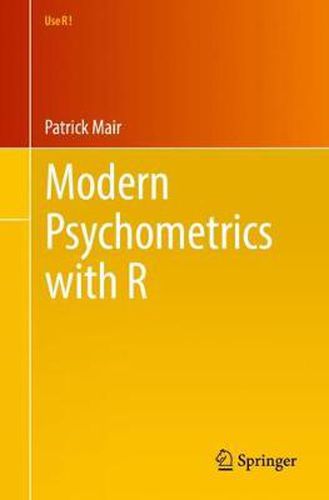
This textbook describes the broadening methodology spectrum of psychological measurement in order to meet the statistical needs of a modern psychologist. The way statistics is used, and maybe even perceived, in psychology has drastically changed over the last few years; computationally as well as methodologically. R has taken the field of psychology by storm, to the point that it can now safely be considered the lingua franca for statistical data analysis in psychology. The goal of this book is to give the reader a starting point when analyzing data using a particular method, including advanced versions, and to hopefully motivate him or her to delve deeper into additional literature on the method.
Beginning with one of the oldest psychometric model formulations, the true score model, Mair devotes the early chapters to exploring confirmatory factor analysis, modern test theory, and a sequence of multivariate exploratory method. Subsequent chapters present special techniques useful for modern psychological applications including correlation networks, sophisticated parametric clustering techniques, longitudinal measurements on a single participant, and functional magnetic resonance imaging (fMRI) data. In addition to using real-life data sets to demonstrate each method, the book also reports each method in three parts– first describing when and why to apply it, then how to compute the method in R, and finally how to present, visualize, and interpret the results. Requiring a basic knowledge of statistical methods and R software, but written in a casual tone, this text is ideal for graduate students in psychology.
Relevant courses include methods of scaling, latent variable modeling, psychometrics for graduate students in Psychology, and multivariate methods in the social sciences.
$9.00 standard shipping within Australia
FREE standard shipping within Australia for orders over $100.00
Express & International shipping calculated at checkout
Stock availability can be subject to change without notice. We recommend calling the shop or contacting our online team to check availability of low stock items. Please see our Shopping Online page for more details.
This title is printed to order. This book may have been self-published. If so, we cannot guarantee the quality of the content. In the main most books will have gone through the editing process however some may not. We therefore suggest that you be aware of this before ordering this book. If in doubt check either the author or publisher’s details as we are unable to accept any returns unless they are faulty. Please contact us if you have any questions.
This textbook describes the broadening methodology spectrum of psychological measurement in order to meet the statistical needs of a modern psychologist. The way statistics is used, and maybe even perceived, in psychology has drastically changed over the last few years; computationally as well as methodologically. R has taken the field of psychology by storm, to the point that it can now safely be considered the lingua franca for statistical data analysis in psychology. The goal of this book is to give the reader a starting point when analyzing data using a particular method, including advanced versions, and to hopefully motivate him or her to delve deeper into additional literature on the method.
Beginning with one of the oldest psychometric model formulations, the true score model, Mair devotes the early chapters to exploring confirmatory factor analysis, modern test theory, and a sequence of multivariate exploratory method. Subsequent chapters present special techniques useful for modern psychological applications including correlation networks, sophisticated parametric clustering techniques, longitudinal measurements on a single participant, and functional magnetic resonance imaging (fMRI) data. In addition to using real-life data sets to demonstrate each method, the book also reports each method in three parts– first describing when and why to apply it, then how to compute the method in R, and finally how to present, visualize, and interpret the results. Requiring a basic knowledge of statistical methods and R software, but written in a casual tone, this text is ideal for graduate students in psychology.
Relevant courses include methods of scaling, latent variable modeling, psychometrics for graduate students in Psychology, and multivariate methods in the social sciences.
Search our extensive online catalogue.
