Readings Newsletter
Become a Readings Member to make your shopping experience even easier.
Sign in or sign up for free!
You’re not far away from qualifying for FREE standard shipping within Australia
You’ve qualified for FREE standard shipping within Australia
The cart is loading…


This title is printed to order. This book may have been self-published. If so, we cannot guarantee the quality of the content. In the main most books will have gone through the editing process however some may not. We therefore suggest that you be aware of this before ordering this book. If in doubt check either the author or publisher’s details as we are unable to accept any returns unless they are faulty. Please contact us if you have any questions.
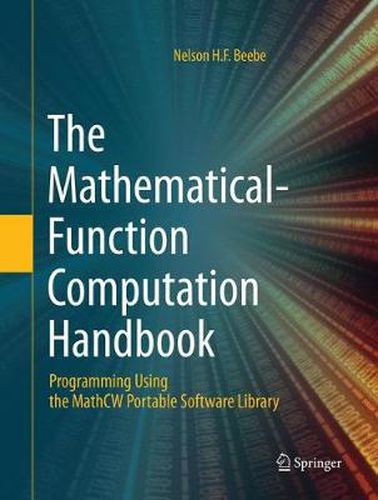
This highly comprehensive handbook provides a substantial advance in the computation of elementary and special functions of mathematics, extending the function coverage of major programming languages well beyond their international standards, including full support for decimal floating-point arithmetic. Written with clarity and focusing on the C language, the work pays extensive attention to little-understood aspects of floating-point and integer arithmetic, and to software portability, as well as to important historical architectures. It extends support to a future 256-bit, floating-point format offering 70 decimal digits of precision.
Select Topics and Features: references an exceptionally useful, author-maintained MathCW website, containing source code for the book’s software, compiled libraries for numerous systems, pre-built
C compilers, and other related materials; offers a unique approach to covering mathematical-function computation using decimal arithmetic; provides extremely versatile appendices for interfaces to numerous other languages: Ada, C#, C++, Fortran, Java, and Pascal; presupposes only basic familiarity with computer programming in a common language, as well as early level algebra; supplies a library that readily adapts for existing scripting languages, with minimal effort; supports both binary and decimal arithmetic, in up to 10 different floating-point formats; covers a significant portion (with highly accurate implementations) of the U.S National Institute of Standards and Technology’s 10-year project to codify mathematical functions.
This highly practical text/reference is an invaluable tool for advanced undergraduates, recording many lessons of the intermingled history of computer hardw
are and software, numerical algorithms, and mathematics. In addition, professional numerical analysts and others will find the handbook of real interest and utility because it builds on research by the mathematical software community over the last four decades.
$9.00 standard shipping within Australia
FREE standard shipping within Australia for orders over $100.00
Express & International shipping calculated at checkout
Stock availability can be subject to change without notice. We recommend calling the shop or contacting our online team to check availability of low stock items. Please see our Shopping Online page for more details.
This title is printed to order. This book may have been self-published. If so, we cannot guarantee the quality of the content. In the main most books will have gone through the editing process however some may not. We therefore suggest that you be aware of this before ordering this book. If in doubt check either the author or publisher’s details as we are unable to accept any returns unless they are faulty. Please contact us if you have any questions.
This highly comprehensive handbook provides a substantial advance in the computation of elementary and special functions of mathematics, extending the function coverage of major programming languages well beyond their international standards, including full support for decimal floating-point arithmetic. Written with clarity and focusing on the C language, the work pays extensive attention to little-understood aspects of floating-point and integer arithmetic, and to software portability, as well as to important historical architectures. It extends support to a future 256-bit, floating-point format offering 70 decimal digits of precision.
Select Topics and Features: references an exceptionally useful, author-maintained MathCW website, containing source code for the book’s software, compiled libraries for numerous systems, pre-built
C compilers, and other related materials; offers a unique approach to covering mathematical-function computation using decimal arithmetic; provides extremely versatile appendices for interfaces to numerous other languages: Ada, C#, C++, Fortran, Java, and Pascal; presupposes only basic familiarity with computer programming in a common language, as well as early level algebra; supplies a library that readily adapts for existing scripting languages, with minimal effort; supports both binary and decimal arithmetic, in up to 10 different floating-point formats; covers a significant portion (with highly accurate implementations) of the U.S National Institute of Standards and Technology’s 10-year project to codify mathematical functions.
This highly practical text/reference is an invaluable tool for advanced undergraduates, recording many lessons of the intermingled history of computer hardw
are and software, numerical algorithms, and mathematics. In addition, professional numerical analysts and others will find the handbook of real interest and utility because it builds on research by the mathematical software community over the last four decades.
Search our extensive online catalogue.
