Readings Newsletter
Become a Readings Member to make your shopping experience even easier.
Sign in or sign up for free!
You’re not far away from qualifying for FREE standard shipping within Australia
You’ve qualified for FREE standard shipping within Australia
The cart is loading…


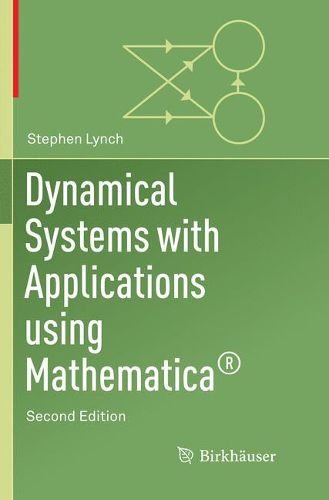
This textbook, now in its second edition, provides a broad introduction to the theory and practice of both continuous and discrete dynamical systems with the aid of the Mathematica software suite. Taking a hands-on approach, the reader is guided from basic concepts to modern research topics. Emphasized throughout are numerous applications to biology, chemical kinetics, economics, electronics, epidemiology, nonlinear optics, mechanics, population dynamics, and neural networks. The book begins with an efficient tutorial introduction to Mathematica, enabling new users to become familiar with the program, while providing a good reference source for experts. Working Mathematica notebooks will be available at:
http://library.wolfram.com/infocenter/Books/9563/
The author has focused on breadth of coverage rather than fine detail, with theorems and proofs being kept to a minimum, though references are included for the inquisitive reader. The book is intended for senior undergraduate and graduate students as well as working scientists in applied mathematics, the natural sciences, and engineering. Many of the chapters are especially useful as reference material for senior undergraduate independent project work. New to the second edition:
Since the first printing of this book in 2007, Mathematica has evolved from version 6.0 to version 11.2 in 2017. Accordingly, the second edition has been thoroughly updated and new material has been added. There are many more applications, examples and exercises, all with solutions, and new sections on series solutions of ordinary differential equations and Newton fractals, have been added. There are also new chapters on delay differential equations, image processing, binary oscillator computing, and simulation with Wolfram SystemModeler. Praise for the first edition:
"[This book's] content and presentation style convey the excitement that has drawn many students and researchers to dynamical systems in the firstplace."
-Dynamical Systems Magazine
"This book presents an original, cheap and powerful solution to the problem of analysis of large data sets."
-Studia Universitatis Babes'-Bolyai Mathematica
"The one-liner programs come to life when typed in, and the growing programming skill lends itself to inventing [one's] own extensions to the supplied problems."
-Datafile, The Journal of the HPCC
$9.00 standard shipping within Australia
FREE standard shipping within Australia for orders over $100.00
Express & International shipping calculated at checkout
Stock availability can be subject to change without notice. We recommend calling the shop or contacting our online team to check availability of low stock items. Please see our Shopping Online page for more details.
This textbook, now in its second edition, provides a broad introduction to the theory and practice of both continuous and discrete dynamical systems with the aid of the Mathematica software suite. Taking a hands-on approach, the reader is guided from basic concepts to modern research topics. Emphasized throughout are numerous applications to biology, chemical kinetics, economics, electronics, epidemiology, nonlinear optics, mechanics, population dynamics, and neural networks. The book begins with an efficient tutorial introduction to Mathematica, enabling new users to become familiar with the program, while providing a good reference source for experts. Working Mathematica notebooks will be available at:
http://library.wolfram.com/infocenter/Books/9563/
The author has focused on breadth of coverage rather than fine detail, with theorems and proofs being kept to a minimum, though references are included for the inquisitive reader. The book is intended for senior undergraduate and graduate students as well as working scientists in applied mathematics, the natural sciences, and engineering. Many of the chapters are especially useful as reference material for senior undergraduate independent project work. New to the second edition:
Since the first printing of this book in 2007, Mathematica has evolved from version 6.0 to version 11.2 in 2017. Accordingly, the second edition has been thoroughly updated and new material has been added. There are many more applications, examples and exercises, all with solutions, and new sections on series solutions of ordinary differential equations and Newton fractals, have been added. There are also new chapters on delay differential equations, image processing, binary oscillator computing, and simulation with Wolfram SystemModeler. Praise for the first edition:
"[This book's] content and presentation style convey the excitement that has drawn many students and researchers to dynamical systems in the firstplace."
-Dynamical Systems Magazine
"This book presents an original, cheap and powerful solution to the problem of analysis of large data sets."
-Studia Universitatis Babes'-Bolyai Mathematica
"The one-liner programs come to life when typed in, and the growing programming skill lends itself to inventing [one's] own extensions to the supplied problems."
-Datafile, The Journal of the HPCC
Search our extensive online catalogue.
