Readings Newsletter
Become a Readings Member to make your shopping experience even easier.
Sign in or sign up for free!
You’re not far away from qualifying for FREE standard shipping within Australia
You’ve qualified for FREE standard shipping within Australia
The cart is loading…


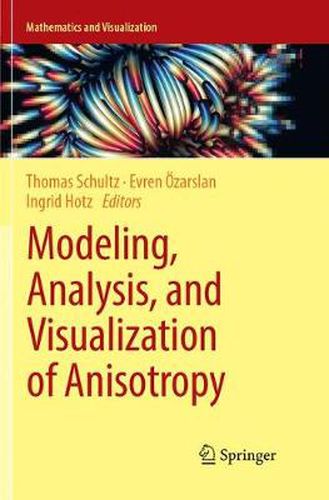
This book focuses on the modeling, processing and visualization of anisotropy, irrespective of the context in which it emerges, using state-of-the-art mathematical tools. As such, it differs substantially from conventional reference works, which are centered on a particular application. It covers the following topics: (i) the geometric structure of tensors, (ii) statistical methods for tensor field processing, (iii) challenges in mapping neural connectivity and structural mechanics, (iv) processing of uncertainty, and (v) visualizing higher-order representations. In addition to original research contributions, it provides insightful reviews.
This multidisciplinary book is the sixth in a series that aims to foster scientific exchange between communities employing tensors and other higher-order representations of directionally dependent data. A significant number of the chapters were co-authored by the participants of the workshop titled Multidisciplinary Approaches to Multivalued Data: Modeling, Visualization, Analysis, which was held in Dagstuhl, Germany in April 2016.
It offers a valuable resource for those working in the field of multi-directional data, vital inspirations for the development of new models, and essential analysis and visualization techniques, thus furthering the state-of-the-art in studies involving anisotropy.
$9.00 standard shipping within Australia
FREE standard shipping within Australia for orders over $100.00
Express & International shipping calculated at checkout
Stock availability can be subject to change without notice. We recommend calling the shop or contacting our online team to check availability of low stock items. Please see our Shopping Online page for more details.
This book focuses on the modeling, processing and visualization of anisotropy, irrespective of the context in which it emerges, using state-of-the-art mathematical tools. As such, it differs substantially from conventional reference works, which are centered on a particular application. It covers the following topics: (i) the geometric structure of tensors, (ii) statistical methods for tensor field processing, (iii) challenges in mapping neural connectivity and structural mechanics, (iv) processing of uncertainty, and (v) visualizing higher-order representations. In addition to original research contributions, it provides insightful reviews.
This multidisciplinary book is the sixth in a series that aims to foster scientific exchange between communities employing tensors and other higher-order representations of directionally dependent data. A significant number of the chapters were co-authored by the participants of the workshop titled Multidisciplinary Approaches to Multivalued Data: Modeling, Visualization, Analysis, which was held in Dagstuhl, Germany in April 2016.
It offers a valuable resource for those working in the field of multi-directional data, vital inspirations for the development of new models, and essential analysis and visualization techniques, thus furthering the state-of-the-art in studies involving anisotropy.
Search our extensive online catalogue.
