Readings Newsletter
Become a Readings Member to make your shopping experience even easier.
Sign in or sign up for free!
You’re not far away from qualifying for FREE standard shipping within Australia
You’ve qualified for FREE standard shipping within Australia
The cart is loading…


This title is printed to order. This book may have been self-published. If so, we cannot guarantee the quality of the content. In the main most books will have gone through the editing process however some may not. We therefore suggest that you be aware of this before ordering this book. If in doubt check either the author or publisher’s details as we are unable to accept any returns unless they are faulty. Please contact us if you have any questions.
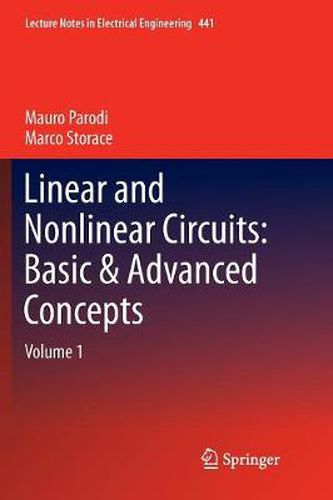
This book provides readers with the necessary background information and advanced concepts in the field of circuits, at the crossroads between physics, mathematics and system theory. It covers various engineering subfields, such as electrical devices and circuits, and their electronic counterparts. Based on the idea that a modern university course should provide students with conceptual tools to understand the behavior of both linear and nonlinear circuits, to approach current problems posed by new, cutting-edge devices and to address future developments and challenges, the book places equal emphasis on linear and nonlinear, two-terminal and multi-terminal, as well as active and passive circuit components. The theory is developed systematically, starting with the simplest circuits (linear, time-invariant and resistive) and providing food for thought on nonlinear circuits, potential functions, linear algebra and geometrical interpretations of selected results. Contents are organized into a set of first-level and a set of advanced-level topics. The book is rich in examples and includes numerous solved problems. Further topics, such as signal processing and modeling of non-electric physical phenomena (e.g., hysteresis or biological oscillators) will be discussed in volume 2.
$9.00 standard shipping within Australia
FREE standard shipping within Australia for orders over $100.00
Express & International shipping calculated at checkout
Stock availability can be subject to change without notice. We recommend calling the shop or contacting our online team to check availability of low stock items. Please see our Shopping Online page for more details.
This title is printed to order. This book may have been self-published. If so, we cannot guarantee the quality of the content. In the main most books will have gone through the editing process however some may not. We therefore suggest that you be aware of this before ordering this book. If in doubt check either the author or publisher’s details as we are unable to accept any returns unless they are faulty. Please contact us if you have any questions.
This book provides readers with the necessary background information and advanced concepts in the field of circuits, at the crossroads between physics, mathematics and system theory. It covers various engineering subfields, such as electrical devices and circuits, and their electronic counterparts. Based on the idea that a modern university course should provide students with conceptual tools to understand the behavior of both linear and nonlinear circuits, to approach current problems posed by new, cutting-edge devices and to address future developments and challenges, the book places equal emphasis on linear and nonlinear, two-terminal and multi-terminal, as well as active and passive circuit components. The theory is developed systematically, starting with the simplest circuits (linear, time-invariant and resistive) and providing food for thought on nonlinear circuits, potential functions, linear algebra and geometrical interpretations of selected results. Contents are organized into a set of first-level and a set of advanced-level topics. The book is rich in examples and includes numerous solved problems. Further topics, such as signal processing and modeling of non-electric physical phenomena (e.g., hysteresis or biological oscillators) will be discussed in volume 2.
Search our extensive online catalogue.
