Readings Newsletter
Become a Readings Member to make your shopping experience even easier.
Sign in or sign up for free!
You’re not far away from qualifying for FREE standard shipping within Australia
You’ve qualified for FREE standard shipping within Australia
The cart is loading…


This title is printed to order. This book may have been self-published. If so, we cannot guarantee the quality of the content. In the main most books will have gone through the editing process however some may not. We therefore suggest that you be aware of this before ordering this book. If in doubt check either the author or publisher’s details as we are unable to accept any returns unless they are faulty. Please contact us if you have any questions.
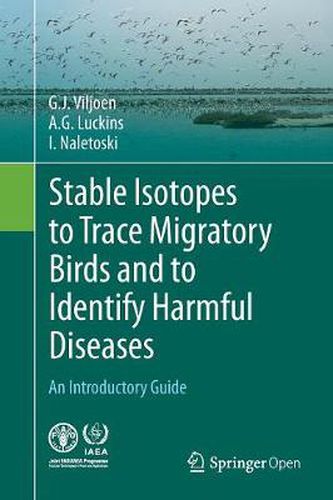
This manuscript discusses the potentials of the approaches as mentioned below to monitor the AIVs in WMW. Molecular diagnostic platforms enable for accurate detection of the AIVs in the feces of infected birds. Similar technologies can be used to determine the bird species through DNA barcoding, enabling non-invasive research on the epidemiology of the disease.
Wild migratory waterfowl (WMW) play significant role in the
transmission of avian influenza viruses (AIVs) on large distances.
Understanding bird migrations may therefore significantly contribute towards
understanding of the disease epidemiology, however most conventional
approaches to trace WMW migrations are based on capturing, tagging (mostly
ringing or GPS devices) and their re-capturing to link the departure and
arrival places.
Stable isotope ratios in metabolically inert tissues (feathers, beaks, claws) reflect the ratios present at the point of intake (drinking or feeding), thus enabling for tracing bird origins at stopover places.
Molecular diagnostic platforms such as the polymerase chain reaction
(PCR) enable for accurate detection of the AIVs in the feces of infected
birds. Similar technologies (genetic sequencing) can be used to determine the
bird species through DNA barcoding. Simple and easy collection of feather and
fecal samples at the stopover places may generate a full information package
on which species of WMW carries the AIVs (PCR+DNA barcoding on the feces), as
well as the origin of these species (SI+DNA barcoding on the feathers).
Therefore, such approaches enable for research on the epidemiology and the
ecology of the AIVs in WMW using a non-invasive platform, which does not
require capturing of WMW. This manuscript discusses the potentials of these
approaches to monitor the AIVs in WMW.
p>
$9.00 standard shipping within Australia
FREE standard shipping within Australia for orders over $100.00
Express & International shipping calculated at checkout
Stock availability can be subject to change without notice. We recommend calling the shop or contacting our online team to check availability of low stock items. Please see our Shopping Online page for more details.
This title is printed to order. This book may have been self-published. If so, we cannot guarantee the quality of the content. In the main most books will have gone through the editing process however some may not. We therefore suggest that you be aware of this before ordering this book. If in doubt check either the author or publisher’s details as we are unable to accept any returns unless they are faulty. Please contact us if you have any questions.
This manuscript discusses the potentials of the approaches as mentioned below to monitor the AIVs in WMW. Molecular diagnostic platforms enable for accurate detection of the AIVs in the feces of infected birds. Similar technologies can be used to determine the bird species through DNA barcoding, enabling non-invasive research on the epidemiology of the disease.
Wild migratory waterfowl (WMW) play significant role in the
transmission of avian influenza viruses (AIVs) on large distances.
Understanding bird migrations may therefore significantly contribute towards
understanding of the disease epidemiology, however most conventional
approaches to trace WMW migrations are based on capturing, tagging (mostly
ringing or GPS devices) and their re-capturing to link the departure and
arrival places.
Stable isotope ratios in metabolically inert tissues (feathers, beaks, claws) reflect the ratios present at the point of intake (drinking or feeding), thus enabling for tracing bird origins at stopover places.
Molecular diagnostic platforms such as the polymerase chain reaction
(PCR) enable for accurate detection of the AIVs in the feces of infected
birds. Similar technologies (genetic sequencing) can be used to determine the
bird species through DNA barcoding. Simple and easy collection of feather and
fecal samples at the stopover places may generate a full information package
on which species of WMW carries the AIVs (PCR+DNA barcoding on the feces), as
well as the origin of these species (SI+DNA barcoding on the feathers).
Therefore, such approaches enable for research on the epidemiology and the
ecology of the AIVs in WMW using a non-invasive platform, which does not
require capturing of WMW. This manuscript discusses the potentials of these
approaches to monitor the AIVs in WMW.
p>
Search our extensive online catalogue.
