Readings Newsletter
Become a Readings Member to make your shopping experience even easier.
Sign in or sign up for free!
You’re not far away from qualifying for FREE standard shipping within Australia
You’ve qualified for FREE standard shipping within Australia
The cart is loading…


This title is printed to order. This book may have been self-published. If so, we cannot guarantee the quality of the content. In the main most books will have gone through the editing process however some may not. We therefore suggest that you be aware of this before ordering this book. If in doubt check either the author or publisher’s details as we are unable to accept any returns unless they are faulty. Please contact us if you have any questions.
This book is published open access under a CC BY 4.0 license.
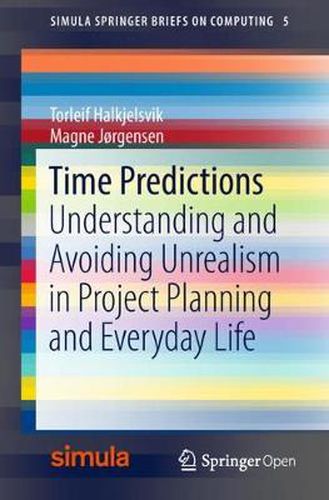
Predicting the time needed to complete a project, task or daily activity can be difficult and people frequently underestimate how long an activity will take. This book sheds light on why and when this happens, what we should do to avoid it and how to give more realistic time predictions. It describes methods for predicting time usage in situations with high uncertainty, explains why two plus two is usually more than four in time prediction contexts, reports on research on time prediction biases, and summarizes the evidence in support of different time prediction methods and principles. Based on a comprehensive review of the research, it is the first book summarizing what we know about judgment-based time predictions.
Large parts of the book are directed toward people wishing to achieve better time predictions in their professional life, such as project managers, graphic designers, architects, engineers, film producers, consultants, software developers, or anyone else in need of realistic time usage predictions. It is also of benefit to those with a general interest in judgment and decision-making or those who want to improve their ability to predict and plan ahead in daily life.
$9.00 standard shipping within Australia
FREE standard shipping within Australia for orders over $100.00
Express & International shipping calculated at checkout
Stock availability can be subject to change without notice. We recommend calling the shop or contacting our online team to check availability of low stock items. Please see our Shopping Online page for more details.
This title is printed to order. This book may have been self-published. If so, we cannot guarantee the quality of the content. In the main most books will have gone through the editing process however some may not. We therefore suggest that you be aware of this before ordering this book. If in doubt check either the author or publisher’s details as we are unable to accept any returns unless they are faulty. Please contact us if you have any questions.
This book is published open access under a CC BY 4.0 license.
Predicting the time needed to complete a project, task or daily activity can be difficult and people frequently underestimate how long an activity will take. This book sheds light on why and when this happens, what we should do to avoid it and how to give more realistic time predictions. It describes methods for predicting time usage in situations with high uncertainty, explains why two plus two is usually more than four in time prediction contexts, reports on research on time prediction biases, and summarizes the evidence in support of different time prediction methods and principles. Based on a comprehensive review of the research, it is the first book summarizing what we know about judgment-based time predictions.
Large parts of the book are directed toward people wishing to achieve better time predictions in their professional life, such as project managers, graphic designers, architects, engineers, film producers, consultants, software developers, or anyone else in need of realistic time usage predictions. It is also of benefit to those with a general interest in judgment and decision-making or those who want to improve their ability to predict and plan ahead in daily life.
Search our extensive online catalogue.
