Readings Newsletter
Become a Readings Member to make your shopping experience even easier.
Sign in or sign up for free!
You’re not far away from qualifying for FREE standard shipping within Australia
You’ve qualified for FREE standard shipping within Australia
The cart is loading…


This title is printed to order. This book may have been self-published. If so, we cannot guarantee the quality of the content. In the main most books will have gone through the editing process however some may not. We therefore suggest that you be aware of this before ordering this book. If in doubt check either the author or publisher’s details as we are unable to accept any returns unless they are faulty. Please contact us if you have any questions.
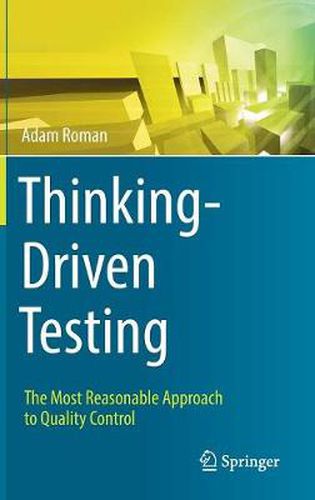
This book presents a new paradigm of software testing by emphasizing the role of critical thinking, system thinking and rationality as the most important skills for the tester. It thus approaches software testing from a different perspective than in past literature, as the vast majority of books describe testing in the context of specific tools, automation, documentation, particular test design techniques or test management. In addition, the book proposes a novel meta-approach for designing effective test strategies, which is based on recent advances in psychology, economics, system sciences and logic. Chapter 1 starts by introducing the fundamental ideas underlying software testing. Chapter 2 then describes meta-strategies in software testing, i.e. general approaches that can be adapted to many different situations that a software tester encounters. Next, Chapter 3 presents the concept of Thinking-Driven Testing (TDT). This approach utilizes the concepts discussed in the two previous chapters and introduces the main ideas that underlie a reasonable and optimal approach to software testing. Chapter 4 builds on this basis and proposes a specific approach to testing, called TQED, that makes it possible to increase creativity in the context of delivering effective, optimal test ideas. Chapter 5 provides an overview of different types of testing techniques in order to understand the fundamental concepts of test design, while Chapter 6 details various pitfalls a tester may encounter and that can originate from a wide range of testing process areas. Lastly, Chapter 7 puts all this into practice, as it contains several exercises that will help testers develop a number of crucial skills: logical thinking and reasoning, thinking out of the box, creativity, counting and estimating, and analytical thinking. By promoting critical, rational and creative thinking, this book invites readers to re-examine common assumptions regarding software testing and shows them how to become professional testers who bring added value to their company.
$9.00 standard shipping within Australia
FREE standard shipping within Australia for orders over $100.00
Express & International shipping calculated at checkout
Stock availability can be subject to change without notice. We recommend calling the shop or contacting our online team to check availability of low stock items. Please see our Shopping Online page for more details.
This title is printed to order. This book may have been self-published. If so, we cannot guarantee the quality of the content. In the main most books will have gone through the editing process however some may not. We therefore suggest that you be aware of this before ordering this book. If in doubt check either the author or publisher’s details as we are unable to accept any returns unless they are faulty. Please contact us if you have any questions.
This book presents a new paradigm of software testing by emphasizing the role of critical thinking, system thinking and rationality as the most important skills for the tester. It thus approaches software testing from a different perspective than in past literature, as the vast majority of books describe testing in the context of specific tools, automation, documentation, particular test design techniques or test management. In addition, the book proposes a novel meta-approach for designing effective test strategies, which is based on recent advances in psychology, economics, system sciences and logic. Chapter 1 starts by introducing the fundamental ideas underlying software testing. Chapter 2 then describes meta-strategies in software testing, i.e. general approaches that can be adapted to many different situations that a software tester encounters. Next, Chapter 3 presents the concept of Thinking-Driven Testing (TDT). This approach utilizes the concepts discussed in the two previous chapters and introduces the main ideas that underlie a reasonable and optimal approach to software testing. Chapter 4 builds on this basis and proposes a specific approach to testing, called TQED, that makes it possible to increase creativity in the context of delivering effective, optimal test ideas. Chapter 5 provides an overview of different types of testing techniques in order to understand the fundamental concepts of test design, while Chapter 6 details various pitfalls a tester may encounter and that can originate from a wide range of testing process areas. Lastly, Chapter 7 puts all this into practice, as it contains several exercises that will help testers develop a number of crucial skills: logical thinking and reasoning, thinking out of the box, creativity, counting and estimating, and analytical thinking. By promoting critical, rational and creative thinking, this book invites readers to re-examine common assumptions regarding software testing and shows them how to become professional testers who bring added value to their company.
Search our extensive online catalogue.
