Readings Newsletter
Become a Readings Member to make your shopping experience even easier.
Sign in or sign up for free!
You’re not far away from qualifying for FREE standard shipping within Australia
You’ve qualified for FREE standard shipping within Australia
The cart is loading…


This title is printed to order. This book may have been self-published. If so, we cannot guarantee the quality of the content. In the main most books will have gone through the editing process however some may not. We therefore suggest that you be aware of this before ordering this book. If in doubt check either the author or publisher’s details as we are unable to accept any returns unless they are faulty. Please contact us if you have any questions.
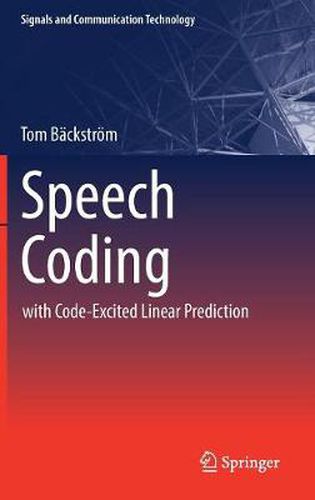
This book provides scientific understanding of the most central techniques used in speech coding both for advanced students as well as professionals with a background in speech audio and or digital signal processing. It provides a clear connection between the Why’s?, How’s?, and What’s, such that the necessity, purpose and solutions provided by tools should be always within sight, as well as their strengths and weaknesses in each respect. Equivalently, this book sheds light on the following perspectives for each technology presented:
Objective: What do we want to achieve and especially why is this goal important?
Resource / Information: What information is available and how can it be useful?
Resource / Platform: What kind of platforms are we working with and what are the capabilities/restrictions of those platforms? This includes properties such as computational, memory, acoustic and transmission capacity of devices used.
Solutions: Which solutions have been proposed and how can they be used to reach the stated goals?
Strengths and weaknesses: In which ways do the solutions fulfill the objectives and where are they insufficient? Are resources used efficiently?
This book concentrates solely on code excited linear prediction and its derivatives since mainstream speech codecs are based on linear prediction It also concentrates exclusively on time domain techniques because frequency domain tools are to a large extent common with audio codecs.
$9.00 standard shipping within Australia
FREE standard shipping within Australia for orders over $100.00
Express & International shipping calculated at checkout
Stock availability can be subject to change without notice. We recommend calling the shop or contacting our online team to check availability of low stock items. Please see our Shopping Online page for more details.
This title is printed to order. This book may have been self-published. If so, we cannot guarantee the quality of the content. In the main most books will have gone through the editing process however some may not. We therefore suggest that you be aware of this before ordering this book. If in doubt check either the author or publisher’s details as we are unable to accept any returns unless they are faulty. Please contact us if you have any questions.
This book provides scientific understanding of the most central techniques used in speech coding both for advanced students as well as professionals with a background in speech audio and or digital signal processing. It provides a clear connection between the Why’s?, How’s?, and What’s, such that the necessity, purpose and solutions provided by tools should be always within sight, as well as their strengths and weaknesses in each respect. Equivalently, this book sheds light on the following perspectives for each technology presented:
Objective: What do we want to achieve and especially why is this goal important?
Resource / Information: What information is available and how can it be useful?
Resource / Platform: What kind of platforms are we working with and what are the capabilities/restrictions of those platforms? This includes properties such as computational, memory, acoustic and transmission capacity of devices used.
Solutions: Which solutions have been proposed and how can they be used to reach the stated goals?
Strengths and weaknesses: In which ways do the solutions fulfill the objectives and where are they insufficient? Are resources used efficiently?
This book concentrates solely on code excited linear prediction and its derivatives since mainstream speech codecs are based on linear prediction It also concentrates exclusively on time domain techniques because frequency domain tools are to a large extent common with audio codecs.
Search our extensive online catalogue.
