Readings Newsletter
Become a Readings Member to make your shopping experience even easier.
Sign in or sign up for free!
You’re not far away from qualifying for FREE standard shipping within Australia
You’ve qualified for FREE standard shipping within Australia
The cart is loading…


This title is printed to order. This book may have been self-published. If so, we cannot guarantee the quality of the content. In the main most books will have gone through the editing process however some may not. We therefore suggest that you be aware of this before ordering this book. If in doubt check either the author or publisher’s details as we are unable to accept any returns unless they are faulty. Please contact us if you have any questions.
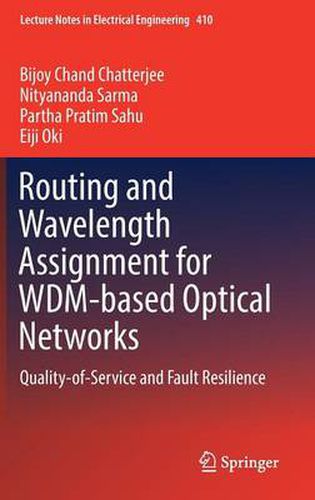
This book presents an in-depth treatment of routing and wavelength assignment for optical networks, and focuses specifically on quality-of-service and fault resiliency issues. It reports on novel approaches for the development of routing and wavelength assignment schemes for fault-resilient optical networks, which improve their performance in terms of signal quality, call blocking, congestion level and reliability, without a substantial increase in network setup cost.
The book first presents a solution for reducing the effect of the wavelength continuity constraint during the routing and wavelength assignment phase. Further, it reports on an approach allowing the incorporation of a traffic grooming mechanism with routing and wavelength assignment to enhance the effective channel utilization of a given capacity optical network using fewer electrical-optical-electrical conversions. As a third step, it addresses a quality of service provision scheme for wavelength-division multiplexing (WDM)-based optical networks. Lastly, the book describes the inclusion of a tree-based fault resilience scheme in priority-based dispersion-reduced wavelength assignment schemes for the purpose of improving network reliability, while maintaining a better utilization of network resources.
Mainly intended for graduate students and researchers, the book provides them with extensive information on both fundamental and advanced technologies for routing and wavelength assignment in optical networks. The topics covered will also be of interest to network planners and designers.
$9.00 standard shipping within Australia
FREE standard shipping within Australia for orders over $100.00
Express & International shipping calculated at checkout
Stock availability can be subject to change without notice. We recommend calling the shop or contacting our online team to check availability of low stock items. Please see our Shopping Online page for more details.
This title is printed to order. This book may have been self-published. If so, we cannot guarantee the quality of the content. In the main most books will have gone through the editing process however some may not. We therefore suggest that you be aware of this before ordering this book. If in doubt check either the author or publisher’s details as we are unable to accept any returns unless they are faulty. Please contact us if you have any questions.
This book presents an in-depth treatment of routing and wavelength assignment for optical networks, and focuses specifically on quality-of-service and fault resiliency issues. It reports on novel approaches for the development of routing and wavelength assignment schemes for fault-resilient optical networks, which improve their performance in terms of signal quality, call blocking, congestion level and reliability, without a substantial increase in network setup cost.
The book first presents a solution for reducing the effect of the wavelength continuity constraint during the routing and wavelength assignment phase. Further, it reports on an approach allowing the incorporation of a traffic grooming mechanism with routing and wavelength assignment to enhance the effective channel utilization of a given capacity optical network using fewer electrical-optical-electrical conversions. As a third step, it addresses a quality of service provision scheme for wavelength-division multiplexing (WDM)-based optical networks. Lastly, the book describes the inclusion of a tree-based fault resilience scheme in priority-based dispersion-reduced wavelength assignment schemes for the purpose of improving network reliability, while maintaining a better utilization of network resources.
Mainly intended for graduate students and researchers, the book provides them with extensive information on both fundamental and advanced technologies for routing and wavelength assignment in optical networks. The topics covered will also be of interest to network planners and designers.
Search our extensive online catalogue.
