Readings Newsletter
Become a Readings Member to make your shopping experience even easier.
Sign in or sign up for free!
You’re not far away from qualifying for FREE standard shipping within Australia
You’ve qualified for FREE standard shipping within Australia
The cart is loading…


This title is printed to order. This book may have been self-published. If so, we cannot guarantee the quality of the content. In the main most books will have gone through the editing process however some may not. We therefore suggest that you be aware of this before ordering this book. If in doubt check either the author or publisher’s details as we are unable to accept any returns unless they are faulty. Please contact us if you have any questions.
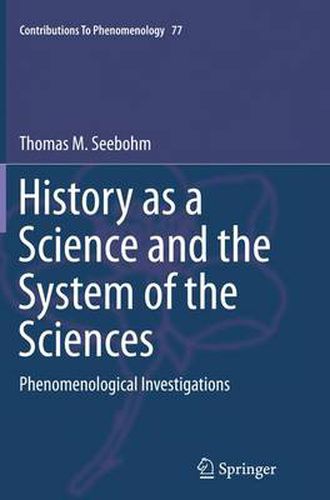
This volume goes beyond presently available phenomenological analyses based on the structures and constitution of the lifeworld. It shows how the science of history is the mediator between the human and the natural sciences. It demonstrates that the distinction between interpretation and explanation does not imply a strict separation of the natural and the human sciences. Finally, it shows that the natural sciences and technology are inseparable, but that technology is one-sidedly founded in pre-scientific encounters with reality in the lifeworld. In positivism the natural sciences are sciences because they offer causal explanations testable in experiments and the humanities are human sciences only if they use methods of the natural sciences. For epistemologists following Dilthey, the human sciences presuppose interpretation and the human and natural sciences must be separated. There is phenomenology interested in psychology and the social sciences that distinguish the natural and the human sciences, but little can be found about the historical human sciences. This volume fills the gap by presenting analyses of the material foundations of the understanding of expressions of other persons, and of primordial recollections and expectations founding explicit expectations and predictions in the lifeworld. Next, it shows, on the basis of history as applying philological methods in interpretations of sources, the role of a universal spatio-temporal framework for reconstructions and causal explanations of what has really happened .
$9.00 standard shipping within Australia
FREE standard shipping within Australia for orders over $100.00
Express & International shipping calculated at checkout
Stock availability can be subject to change without notice. We recommend calling the shop or contacting our online team to check availability of low stock items. Please see our Shopping Online page for more details.
This title is printed to order. This book may have been self-published. If so, we cannot guarantee the quality of the content. In the main most books will have gone through the editing process however some may not. We therefore suggest that you be aware of this before ordering this book. If in doubt check either the author or publisher’s details as we are unable to accept any returns unless they are faulty. Please contact us if you have any questions.
This volume goes beyond presently available phenomenological analyses based on the structures and constitution of the lifeworld. It shows how the science of history is the mediator between the human and the natural sciences. It demonstrates that the distinction between interpretation and explanation does not imply a strict separation of the natural and the human sciences. Finally, it shows that the natural sciences and technology are inseparable, but that technology is one-sidedly founded in pre-scientific encounters with reality in the lifeworld. In positivism the natural sciences are sciences because they offer causal explanations testable in experiments and the humanities are human sciences only if they use methods of the natural sciences. For epistemologists following Dilthey, the human sciences presuppose interpretation and the human and natural sciences must be separated. There is phenomenology interested in psychology and the social sciences that distinguish the natural and the human sciences, but little can be found about the historical human sciences. This volume fills the gap by presenting analyses of the material foundations of the understanding of expressions of other persons, and of primordial recollections and expectations founding explicit expectations and predictions in the lifeworld. Next, it shows, on the basis of history as applying philological methods in interpretations of sources, the role of a universal spatio-temporal framework for reconstructions and causal explanations of what has really happened .
Search our extensive online catalogue.
