Readings Newsletter
Become a Readings Member to make your shopping experience even easier.
Sign in or sign up for free!
You’re not far away from qualifying for FREE standard shipping within Australia
You’ve qualified for FREE standard shipping within Australia
The cart is loading…


This title is printed to order. This book may have been self-published. If so, we cannot guarantee the quality of the content. In the main most books will have gone through the editing process however some may not. We therefore suggest that you be aware of this before ordering this book. If in doubt check either the author or publisher’s details as we are unable to accept any returns unless they are faulty. Please contact us if you have any questions.
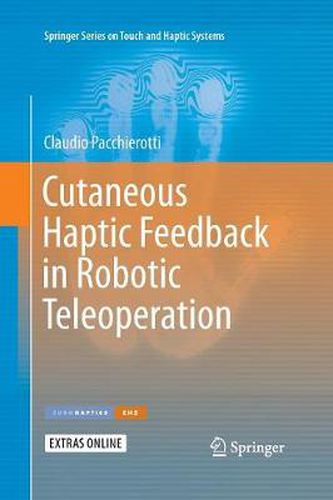
This work addresses the challenge of providing effective cutaneous haptic feedback in robotic teleoperation, with the objective of achieving the highest degree of transparency whilst guaranteeing the stability of the considered systems. On the one hand, it evaluates teleoperation systems that provide only cutaneous cues to the operator, thus guaranteeing the highest degree of safety. This cutaneous-only approach shows intermediate performance between no force feedback and full haptic feedback provided by a grounded haptic interface, and it is best suitable for those scenarios where the safety of the system is paramount, e.g., robotic surgery. On the other hand, in order to achieve a higher level of performance, this work also investigates novel robotic teleoperation systems with force reflection able to provide mixed cutaneous and kinesthetic cues to the operator. Cutaneous cues can compensate for the temporary reduction of kinesthetic feedback necessary to satisfy certain stability conditions.
This state-of-the-art volume is oriented toward researchers, educators, and students who are interested in force feedback techniques for robotic teleoperation, cutaneous device design, cutaneous rendering methods and perception studies, as well as readers from different disciplines who are interested in applying cutaneous haptic technologies and methods to their field of interest.
$9.00 standard shipping within Australia
FREE standard shipping within Australia for orders over $100.00
Express & International shipping calculated at checkout
Stock availability can be subject to change without notice. We recommend calling the shop or contacting our online team to check availability of low stock items. Please see our Shopping Online page for more details.
This title is printed to order. This book may have been self-published. If so, we cannot guarantee the quality of the content. In the main most books will have gone through the editing process however some may not. We therefore suggest that you be aware of this before ordering this book. If in doubt check either the author or publisher’s details as we are unable to accept any returns unless they are faulty. Please contact us if you have any questions.
This work addresses the challenge of providing effective cutaneous haptic feedback in robotic teleoperation, with the objective of achieving the highest degree of transparency whilst guaranteeing the stability of the considered systems. On the one hand, it evaluates teleoperation systems that provide only cutaneous cues to the operator, thus guaranteeing the highest degree of safety. This cutaneous-only approach shows intermediate performance between no force feedback and full haptic feedback provided by a grounded haptic interface, and it is best suitable for those scenarios where the safety of the system is paramount, e.g., robotic surgery. On the other hand, in order to achieve a higher level of performance, this work also investigates novel robotic teleoperation systems with force reflection able to provide mixed cutaneous and kinesthetic cues to the operator. Cutaneous cues can compensate for the temporary reduction of kinesthetic feedback necessary to satisfy certain stability conditions.
This state-of-the-art volume is oriented toward researchers, educators, and students who are interested in force feedback techniques for robotic teleoperation, cutaneous device design, cutaneous rendering methods and perception studies, as well as readers from different disciplines who are interested in applying cutaneous haptic technologies and methods to their field of interest.
Search our extensive online catalogue.
