Readings Newsletter
Become a Readings Member to make your shopping experience even easier.
Sign in or sign up for free!
You’re not far away from qualifying for FREE standard shipping within Australia
You’ve qualified for FREE standard shipping within Australia
The cart is loading…


This title is printed to order. This book may have been self-published. If so, we cannot guarantee the quality of the content. In the main most books will have gone through the editing process however some may not. We therefore suggest that you be aware of this before ordering this book. If in doubt check either the author or publisher’s details as we are unable to accept any returns unless they are faulty. Please contact us if you have any questions.
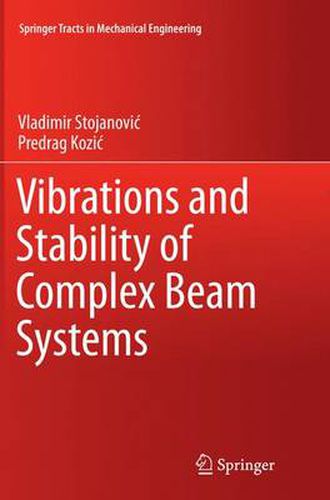
This book reports on solved problems concerning vibrations and stability of complex beam systems. The complexity of a system is considered from two points of view: the complexity originating from the nature of the structure, in the case of two or more elastically connected beams; and the complexity derived from the dynamic behavior of the system, in the case of a damaged single beam, resulting from the harm done to its simple structure. Furthermore, the book describes the analytical derivation of equations of two or more elastically connected beams, using four different theories (Euler, Rayleigh, Timoshenko and Reddy-Bickford). It also reports on a new, improved p-version of the finite element method for geometrically nonlinear vibrations. The new method provides more accurate approximations of solutions, while also allowing us to analyze geometrically nonlinear vibrations. The book describes the appearance of longitudinal vibrations of damaged clamped-clamped beams as a result of discontinuity (damage). It describes the cases of stability in detail, employing all four theories, and provides the readers with practical examples of stochastic stability. Overall, the book succeeds in collecting in one place theoretical analyses, mathematical modeling and validation approaches based on various methods, thus providing the readers with a comprehensive toolkit for performing vibration analysis on complex beam systems.
$9.00 standard shipping within Australia
FREE standard shipping within Australia for orders over $100.00
Express & International shipping calculated at checkout
Stock availability can be subject to change without notice. We recommend calling the shop or contacting our online team to check availability of low stock items. Please see our Shopping Online page for more details.
This title is printed to order. This book may have been self-published. If so, we cannot guarantee the quality of the content. In the main most books will have gone through the editing process however some may not. We therefore suggest that you be aware of this before ordering this book. If in doubt check either the author or publisher’s details as we are unable to accept any returns unless they are faulty. Please contact us if you have any questions.
This book reports on solved problems concerning vibrations and stability of complex beam systems. The complexity of a system is considered from two points of view: the complexity originating from the nature of the structure, in the case of two or more elastically connected beams; and the complexity derived from the dynamic behavior of the system, in the case of a damaged single beam, resulting from the harm done to its simple structure. Furthermore, the book describes the analytical derivation of equations of two or more elastically connected beams, using four different theories (Euler, Rayleigh, Timoshenko and Reddy-Bickford). It also reports on a new, improved p-version of the finite element method for geometrically nonlinear vibrations. The new method provides more accurate approximations of solutions, while also allowing us to analyze geometrically nonlinear vibrations. The book describes the appearance of longitudinal vibrations of damaged clamped-clamped beams as a result of discontinuity (damage). It describes the cases of stability in detail, employing all four theories, and provides the readers with practical examples of stochastic stability. Overall, the book succeeds in collecting in one place theoretical analyses, mathematical modeling and validation approaches based on various methods, thus providing the readers with a comprehensive toolkit for performing vibration analysis on complex beam systems.
Search our extensive online catalogue.
