Readings Newsletter
Become a Readings Member to make your shopping experience even easier.
Sign in or sign up for free!
You’re not far away from qualifying for FREE standard shipping within Australia
You’ve qualified for FREE standard shipping within Australia
The cart is loading…


This title is printed to order. This book may have been self-published. If so, we cannot guarantee the quality of the content. In the main most books will have gone through the editing process however some may not. We therefore suggest that you be aware of this before ordering this book. If in doubt check either the author or publisher’s details as we are unable to accept any returns unless they are faulty. Please contact us if you have any questions.
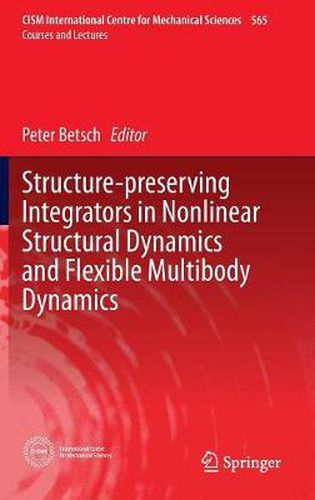
This book focuses on structure-preserving numerical methods for flexible multibody dynamics, including nonlinear elastodynamics and geometrically exact models for beams and shells. It also deals with the newly emerging class of variational integrators as well as Lie-group integrators. It discusses two alternative approaches to the discretization in space of nonlinear beams and shells. Firstly, geometrically exact formulations, which are typically used in the finite element community and, secondly, the absolute nodal coordinate formulation, which is popular in the multibody dynamics community. Concerning the discretization in time, the energy-momentum method and its energy-decaying variants are discussed. It also addresses a number of issues that have arisen in the wake of the structure-preserving discretization in space. Among them are the parameterization of finite rotations, the incorporation of algebraic constraints and the computer implementation of the various numerical methods. The practical application of structure-preserving methods is illustrated by a number of examples dealing with, among others, nonlinear beams and shells, large deformation problems, long-term simulations and coupled thermo-mechanical multibody systems. In addition it links novel time integration methods to frequently used methods in industrial multibody system simulation.
$9.00 standard shipping within Australia
FREE standard shipping within Australia for orders over $100.00
Express & International shipping calculated at checkout
Stock availability can be subject to change without notice. We recommend calling the shop or contacting our online team to check availability of low stock items. Please see our Shopping Online page for more details.
This title is printed to order. This book may have been self-published. If so, we cannot guarantee the quality of the content. In the main most books will have gone through the editing process however some may not. We therefore suggest that you be aware of this before ordering this book. If in doubt check either the author or publisher’s details as we are unable to accept any returns unless they are faulty. Please contact us if you have any questions.
This book focuses on structure-preserving numerical methods for flexible multibody dynamics, including nonlinear elastodynamics and geometrically exact models for beams and shells. It also deals with the newly emerging class of variational integrators as well as Lie-group integrators. It discusses two alternative approaches to the discretization in space of nonlinear beams and shells. Firstly, geometrically exact formulations, which are typically used in the finite element community and, secondly, the absolute nodal coordinate formulation, which is popular in the multibody dynamics community. Concerning the discretization in time, the energy-momentum method and its energy-decaying variants are discussed. It also addresses a number of issues that have arisen in the wake of the structure-preserving discretization in space. Among them are the parameterization of finite rotations, the incorporation of algebraic constraints and the computer implementation of the various numerical methods. The practical application of structure-preserving methods is illustrated by a number of examples dealing with, among others, nonlinear beams and shells, large deformation problems, long-term simulations and coupled thermo-mechanical multibody systems. In addition it links novel time integration methods to frequently used methods in industrial multibody system simulation.
Search our extensive online catalogue.
