Readings Newsletter
Become a Readings Member to make your shopping experience even easier.
Sign in or sign up for free!
You’re not far away from qualifying for FREE standard shipping within Australia
You’ve qualified for FREE standard shipping within Australia
The cart is loading…


This title is printed to order. This book may have been self-published. If so, we cannot guarantee the quality of the content. In the main most books will have gone through the editing process however some may not. We therefore suggest that you be aware of this before ordering this book. If in doubt check either the author or publisher’s details as we are unable to accept any returns unless they are faulty. Please contact us if you have any questions.
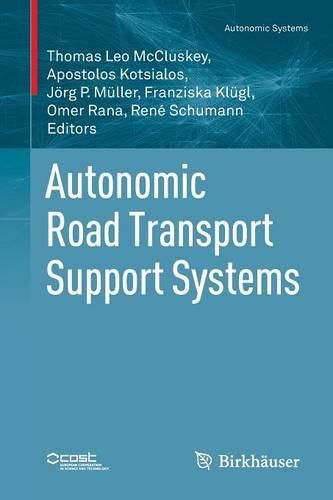
The work on Autonomic Road Transport Support (ARTS) presented here aims at meeting the challenge of engineering autonomic behavior in Intelligent Transportation Systems (ITS) by fusing research from the disciplines of traffic engineering and autonomic computing. Ideas and techniques from leading edge artificial intelligence research have been adapted for ITS over the last 30 years. Examples include adaptive control embedded in real time traffic control systems, heuristic algorithms (e.g. in SAT-NAV systems), image processing and computer vision (e.g. in automated surveillance interpretation). Autonomic computing which is inspired from the biological example of the body's autonomic nervous system is a more recent development. It allows for a more efficient management of heterogeneous distributed computing systems. In the area of computing, autonomic systems are endowed with a number of properties that are generally referred to as self-X properties, including self-configuration, self-healing, self-optimization, self-protection and more generally self-management. Some isolated examples of autonomic properties such as self-adaptation have found their way into ITS technology and have already proved beneficial. This edited volume provides a comprehensive introduction to Autonomic Road Transport Support (ARTS) and describes the development of ARTS systems. It starts out with the visions, opportunities and challenges, then presents the foundations of ARTS and the platforms and methods used and it closes with experiences from real-world applications and prototypes of emerging applications. This makes it suitable for researchers and practitioners in the fields of autonomic computing, traffic and transport management and engineering, AI, and software engineering. Graduate students will benefit from state-of-the-art description, the study of novel methods and the case studies provided.
$9.00 standard shipping within Australia
FREE standard shipping within Australia for orders over $100.00
Express & International shipping calculated at checkout
Stock availability can be subject to change without notice. We recommend calling the shop or contacting our online team to check availability of low stock items. Please see our Shopping Online page for more details.
This title is printed to order. This book may have been self-published. If so, we cannot guarantee the quality of the content. In the main most books will have gone through the editing process however some may not. We therefore suggest that you be aware of this before ordering this book. If in doubt check either the author or publisher’s details as we are unable to accept any returns unless they are faulty. Please contact us if you have any questions.
The work on Autonomic Road Transport Support (ARTS) presented here aims at meeting the challenge of engineering autonomic behavior in Intelligent Transportation Systems (ITS) by fusing research from the disciplines of traffic engineering and autonomic computing. Ideas and techniques from leading edge artificial intelligence research have been adapted for ITS over the last 30 years. Examples include adaptive control embedded in real time traffic control systems, heuristic algorithms (e.g. in SAT-NAV systems), image processing and computer vision (e.g. in automated surveillance interpretation). Autonomic computing which is inspired from the biological example of the body's autonomic nervous system is a more recent development. It allows for a more efficient management of heterogeneous distributed computing systems. In the area of computing, autonomic systems are endowed with a number of properties that are generally referred to as self-X properties, including self-configuration, self-healing, self-optimization, self-protection and more generally self-management. Some isolated examples of autonomic properties such as self-adaptation have found their way into ITS technology and have already proved beneficial. This edited volume provides a comprehensive introduction to Autonomic Road Transport Support (ARTS) and describes the development of ARTS systems. It starts out with the visions, opportunities and challenges, then presents the foundations of ARTS and the platforms and methods used and it closes with experiences from real-world applications and prototypes of emerging applications. This makes it suitable for researchers and practitioners in the fields of autonomic computing, traffic and transport management and engineering, AI, and software engineering. Graduate students will benefit from state-of-the-art description, the study of novel methods and the case studies provided.
Search our extensive online catalogue.
