Readings Newsletter
Become a Readings Member to make your shopping experience even easier.
Sign in or sign up for free!
You’re not far away from qualifying for FREE standard shipping within Australia
You’ve qualified for FREE standard shipping within Australia
The cart is loading…


This title is printed to order. This book may have been self-published. If so, we cannot guarantee the quality of the content. In the main most books will have gone through the editing process however some may not. We therefore suggest that you be aware of this before ordering this book. If in doubt check either the author or publisher’s details as we are unable to accept any returns unless they are faulty. Please contact us if you have any questions.
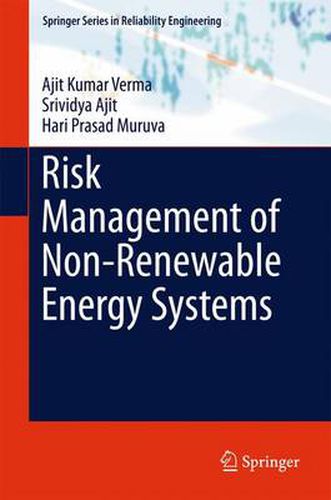
This book describes the basic concepts of risk and reliability with detailed descriptions of the different levels of probabilistic safety assessment of nuclear power plants (both internal and external). The book also maximizes readers insights into time dependent risk analysis through several case studies, whilst risk management with respect to non renewable energy sources is also explained. With several advanced reactors utilizing the concept of passive systems, the reliability estimation of these systems are explained in detail with the book providing a reliability estimation of components through mechanistic model approach. This book is useful for advanced undergraduate and post graduate students in nuclear engineering, aerospace engineering, industrial engineering, reliability and safety engineering, systems engineering and applied probability and statistics. This book is also suitable for one-semester graduate courses on risk management of non renewable energy systems in all conventional engineering branches like civil, mechanical, chemical, electrical and electronics as well as computer science. It will also be a valuable reference for practicing engineers, managers and researchers involved in reliability and safety activities of complex engineering systems.
$9.00 standard shipping within Australia
FREE standard shipping within Australia for orders over $100.00
Express & International shipping calculated at checkout
Stock availability can be subject to change without notice. We recommend calling the shop or contacting our online team to check availability of low stock items. Please see our Shopping Online page for more details.
This title is printed to order. This book may have been self-published. If so, we cannot guarantee the quality of the content. In the main most books will have gone through the editing process however some may not. We therefore suggest that you be aware of this before ordering this book. If in doubt check either the author or publisher’s details as we are unable to accept any returns unless they are faulty. Please contact us if you have any questions.
This book describes the basic concepts of risk and reliability with detailed descriptions of the different levels of probabilistic safety assessment of nuclear power plants (both internal and external). The book also maximizes readers insights into time dependent risk analysis through several case studies, whilst risk management with respect to non renewable energy sources is also explained. With several advanced reactors utilizing the concept of passive systems, the reliability estimation of these systems are explained in detail with the book providing a reliability estimation of components through mechanistic model approach. This book is useful for advanced undergraduate and post graduate students in nuclear engineering, aerospace engineering, industrial engineering, reliability and safety engineering, systems engineering and applied probability and statistics. This book is also suitable for one-semester graduate courses on risk management of non renewable energy systems in all conventional engineering branches like civil, mechanical, chemical, electrical and electronics as well as computer science. It will also be a valuable reference for practicing engineers, managers and researchers involved in reliability and safety activities of complex engineering systems.
Search our extensive online catalogue.
