Readings Newsletter
Become a Readings Member to make your shopping experience even easier.
Sign in or sign up for free!
You’re not far away from qualifying for FREE standard shipping within Australia
You’ve qualified for FREE standard shipping within Australia
The cart is loading…


This title is printed to order. This book may have been self-published. If so, we cannot guarantee the quality of the content. In the main most books will have gone through the editing process however some may not. We therefore suggest that you be aware of this before ordering this book. If in doubt check either the author or publisher’s details as we are unable to accept any returns unless they are faulty. Please contact us if you have any questions.
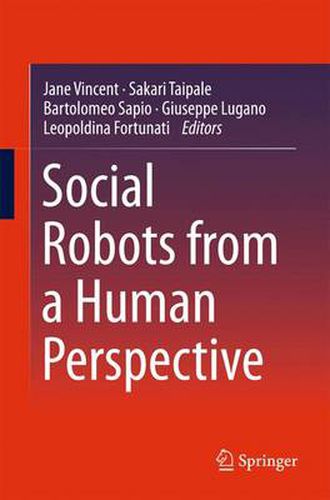
This book presents a comprehensive overview of the human dimension of social robots by discussing both transnational features and national peculiarities. Addressing several issues that explore the human side of social robots, this book investigates what a social robot is and how we might come to think about social robots in the different areas of everyday life. Organized around three sections that deal with Perceptions and Attitudes to Social Robots, Human Interaction with Social Robots, and Social Robots in Everyday Life, it explores the idea that even if the challenges of robot technologies can be overcome from a technological perspective, the question remains as to what kind of machine we want to have and use in our daily lives.
Lessons learned from previous widely adopted technologies, such as smartphones, indicate that robot technologies could potentially be absorbed into the everyday lives of humans in such a way that it is the human that determines the human-machine interaction. In a similar way to how today’s information and communication technologies were initially designed for professional/industrial use, but were soon commercialized for the mass market and then personalized by humans in the course of daily practice, the use of social robots is now facing the same revolution of ‘domestication.’ In the context of this transformation, which involves the profound embedding of robots in everyday life, the ‘human’ aspect of social robots will play a major part. This book sheds new light on this highly topical issue, one of the central subjects that will be taught and studied at universities worldwide and that will be discussed widely, publicly and repeatedly in the near future.
$9.00 standard shipping within Australia
FREE standard shipping within Australia for orders over $100.00
Express & International shipping calculated at checkout
Stock availability can be subject to change without notice. We recommend calling the shop or contacting our online team to check availability of low stock items. Please see our Shopping Online page for more details.
This title is printed to order. This book may have been self-published. If so, we cannot guarantee the quality of the content. In the main most books will have gone through the editing process however some may not. We therefore suggest that you be aware of this before ordering this book. If in doubt check either the author or publisher’s details as we are unable to accept any returns unless they are faulty. Please contact us if you have any questions.
This book presents a comprehensive overview of the human dimension of social robots by discussing both transnational features and national peculiarities. Addressing several issues that explore the human side of social robots, this book investigates what a social robot is and how we might come to think about social robots in the different areas of everyday life. Organized around three sections that deal with Perceptions and Attitudes to Social Robots, Human Interaction with Social Robots, and Social Robots in Everyday Life, it explores the idea that even if the challenges of robot technologies can be overcome from a technological perspective, the question remains as to what kind of machine we want to have and use in our daily lives.
Lessons learned from previous widely adopted technologies, such as smartphones, indicate that robot technologies could potentially be absorbed into the everyday lives of humans in such a way that it is the human that determines the human-machine interaction. In a similar way to how today’s information and communication technologies were initially designed for professional/industrial use, but were soon commercialized for the mass market and then personalized by humans in the course of daily practice, the use of social robots is now facing the same revolution of ‘domestication.’ In the context of this transformation, which involves the profound embedding of robots in everyday life, the ‘human’ aspect of social robots will play a major part. This book sheds new light on this highly topical issue, one of the central subjects that will be taught and studied at universities worldwide and that will be discussed widely, publicly and repeatedly in the near future.
Search our extensive online catalogue.
