Readings Newsletter
Become a Readings Member to make your shopping experience even easier.
Sign in or sign up for free!
You’re not far away from qualifying for FREE standard shipping within Australia
You’ve qualified for FREE standard shipping within Australia
The cart is loading…


This title is printed to order. This book may have been self-published. If so, we cannot guarantee the quality of the content. In the main most books will have gone through the editing process however some may not. We therefore suggest that you be aware of this before ordering this book. If in doubt check either the author or publisher’s details as we are unable to accept any returns unless they are faulty. Please contact us if you have any questions.
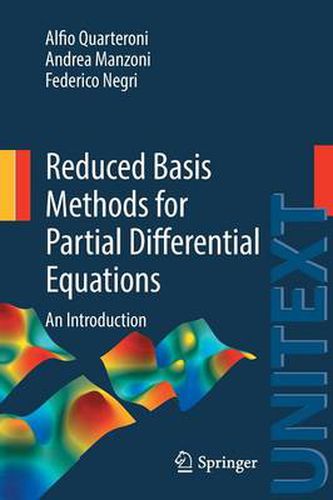
This book provides a basic introduction to reduced basis (RB) methods for problems involving the repeated solution of partial differential equations (PDEs) arising from engineering and applied sciences, such as PDEs depending on several parameters and PDE-constrained optimization.
The book presents a general mathematical formulation of RB methods, analyzes their fundamental theoretical properties, discusses the related algorithmic and implementation aspects, and highlights their built-in algebraic and geometric structures.
More specifically, the authors discuss alternative strategies for constructing accurate RB spaces using greedy algorithms and proper orthogonal decomposition techniques, investigate their approximation properties and analyze offline-online decomposition strategies aimed at the reduction of computational complexity. Furthermore, they carry out both a priori and a posteriori error analysis.
The whole mathematical presentation is made more stimulating by the use of representative examples of applicative interest in the context of both linear and nonlinear PDEs. Moreover, the inclusion of many pseudocodes allows the reader to easily implement the algorithms illustrated throughout the text. The book will be ideal for upper undergraduate students and, more generally, people interested in scientific computing.
All these pseudocodes are in fact implemented in a MATLAB package that is freely available at https://github.com/redbkit
$9.00 standard shipping within Australia
FREE standard shipping within Australia for orders over $100.00
Express & International shipping calculated at checkout
Stock availability can be subject to change without notice. We recommend calling the shop or contacting our online team to check availability of low stock items. Please see our Shopping Online page for more details.
This title is printed to order. This book may have been self-published. If so, we cannot guarantee the quality of the content. In the main most books will have gone through the editing process however some may not. We therefore suggest that you be aware of this before ordering this book. If in doubt check either the author or publisher’s details as we are unable to accept any returns unless they are faulty. Please contact us if you have any questions.
This book provides a basic introduction to reduced basis (RB) methods for problems involving the repeated solution of partial differential equations (PDEs) arising from engineering and applied sciences, such as PDEs depending on several parameters and PDE-constrained optimization.
The book presents a general mathematical formulation of RB methods, analyzes their fundamental theoretical properties, discusses the related algorithmic and implementation aspects, and highlights their built-in algebraic and geometric structures.
More specifically, the authors discuss alternative strategies for constructing accurate RB spaces using greedy algorithms and proper orthogonal decomposition techniques, investigate their approximation properties and analyze offline-online decomposition strategies aimed at the reduction of computational complexity. Furthermore, they carry out both a priori and a posteriori error analysis.
The whole mathematical presentation is made more stimulating by the use of representative examples of applicative interest in the context of both linear and nonlinear PDEs. Moreover, the inclusion of many pseudocodes allows the reader to easily implement the algorithms illustrated throughout the text. The book will be ideal for upper undergraduate students and, more generally, people interested in scientific computing.
All these pseudocodes are in fact implemented in a MATLAB package that is freely available at https://github.com/redbkit
Search our extensive online catalogue.
