Readings Newsletter
Become a Readings Member to make your shopping experience even easier.
Sign in or sign up for free!
You’re not far away from qualifying for FREE standard shipping within Australia
You’ve qualified for FREE standard shipping within Australia
The cart is loading…


This title is printed to order. This book may have been self-published. If so, we cannot guarantee the quality of the content. In the main most books will have gone through the editing process however some may not. We therefore suggest that you be aware of this before ordering this book. If in doubt check either the author or publisher’s details as we are unable to accept any returns unless they are faulty. Please contact us if you have any questions.
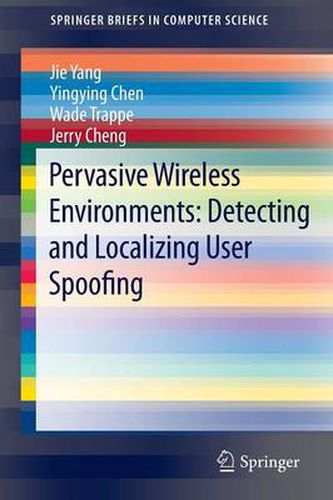
This Springer Brief provides a new approach to prevent user spoofing by using the physical properties associated with wireless transmissions to detect the presence of user spoofing. The most common method, applying cryptographic authentication, requires additional management and computational power that cannot be deployed consistently. The authors present the new approach by offering a summary of the recent research and exploring the benefits and potential challenges of this method.
This brief discusses the feasibility of launching user spoofing attacks and their impact on the wireless and sensor networks. Readers are equipped to understand several system models. One attack detection model exploits the spatial correlation of received signal strength (RSS) inherited from wireless devices as a foundation. Through experiments in practical environments, the authors evaluate the performance of the spoofing attack detection model. The brief also introduces the DEMOTE system, which exploits the correlation within the RSS trace based on each device’s identity to detect mobile attackers. A final chapter covers future directions of this field. By presenting complex technical information in a concise format, this brief is a valuable resource for researchers, professionals, and advanced-level students focused on wireless network security.
$9.00 standard shipping within Australia
FREE standard shipping within Australia for orders over $100.00
Express & International shipping calculated at checkout
Stock availability can be subject to change without notice. We recommend calling the shop or contacting our online team to check availability of low stock items. Please see our Shopping Online page for more details.
This title is printed to order. This book may have been self-published. If so, we cannot guarantee the quality of the content. In the main most books will have gone through the editing process however some may not. We therefore suggest that you be aware of this before ordering this book. If in doubt check either the author or publisher’s details as we are unable to accept any returns unless they are faulty. Please contact us if you have any questions.
This Springer Brief provides a new approach to prevent user spoofing by using the physical properties associated with wireless transmissions to detect the presence of user spoofing. The most common method, applying cryptographic authentication, requires additional management and computational power that cannot be deployed consistently. The authors present the new approach by offering a summary of the recent research and exploring the benefits and potential challenges of this method.
This brief discusses the feasibility of launching user spoofing attacks and their impact on the wireless and sensor networks. Readers are equipped to understand several system models. One attack detection model exploits the spatial correlation of received signal strength (RSS) inherited from wireless devices as a foundation. Through experiments in practical environments, the authors evaluate the performance of the spoofing attack detection model. The brief also introduces the DEMOTE system, which exploits the correlation within the RSS trace based on each device’s identity to detect mobile attackers. A final chapter covers future directions of this field. By presenting complex technical information in a concise format, this brief is a valuable resource for researchers, professionals, and advanced-level students focused on wireless network security.
Search our extensive online catalogue.
