Readings Newsletter
Become a Readings Member to make your shopping experience even easier.
Sign in or sign up for free!
You’re not far away from qualifying for FREE standard shipping within Australia
You’ve qualified for FREE standard shipping within Australia
The cart is loading…


This title is printed to order. This book may have been self-published. If so, we cannot guarantee the quality of the content. In the main most books will have gone through the editing process however some may not. We therefore suggest that you be aware of this before ordering this book. If in doubt check either the author or publisher’s details as we are unable to accept any returns unless they are faulty. Please contact us if you have any questions.
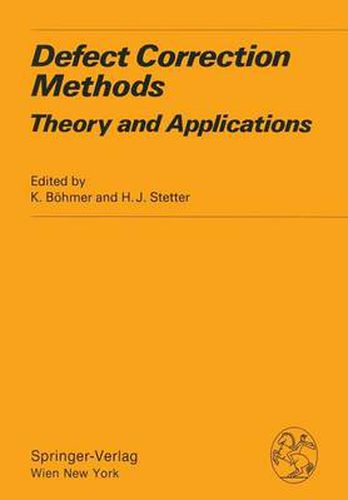
Ten years ago, the term defect correction was introduced to characterize a class of methods for the improvement of an approximate solution of an operator equation. This class includes many well-known techniques (e.g. Newton’s method) but also some novel approaches which have turned out to be quite efficient. Meanwhile a large number of papers and reports, scattered over many journals and institutions, have appeared in this area. Therefore, a working conference on Error Asymptotics and Defect Corrections was organized by K. Bohmer, V. Pereyra and H. J. Stetter at the Mathematisches Forschungsinstitut Oberwolfach in July 1983, a meeting which aimed at bringing together a good number of the scientists who are active in this field. Altogether 26 persons attended, whose interests covered a wide spectrum from theoretical analyses to applications where defect corrections may be utilized; a list of the participants may be found in the Appendix. Most of the colleagues who presented formal lectures at the meeting agreed to publish their reports in this volume. It would be presumptuous to call this book a state-of-the-art report in defect corrections. It is rather a collection of snapshots of activities which have been going on in a number of segments on the frontiers of this area. No systematic coverage has been attempted. Some articles focus strongly on the basic concepts of defect correction; but in the majority of the contributions the defect correction ideas appear rather as instruments for the attainment of some specified goal.
$9.00 standard shipping within Australia
FREE standard shipping within Australia for orders over $100.00
Express & International shipping calculated at checkout
Stock availability can be subject to change without notice. We recommend calling the shop or contacting our online team to check availability of low stock items. Please see our Shopping Online page for more details.
This title is printed to order. This book may have been self-published. If so, we cannot guarantee the quality of the content. In the main most books will have gone through the editing process however some may not. We therefore suggest that you be aware of this before ordering this book. If in doubt check either the author or publisher’s details as we are unable to accept any returns unless they are faulty. Please contact us if you have any questions.
Ten years ago, the term defect correction was introduced to characterize a class of methods for the improvement of an approximate solution of an operator equation. This class includes many well-known techniques (e.g. Newton’s method) but also some novel approaches which have turned out to be quite efficient. Meanwhile a large number of papers and reports, scattered over many journals and institutions, have appeared in this area. Therefore, a working conference on Error Asymptotics and Defect Corrections was organized by K. Bohmer, V. Pereyra and H. J. Stetter at the Mathematisches Forschungsinstitut Oberwolfach in July 1983, a meeting which aimed at bringing together a good number of the scientists who are active in this field. Altogether 26 persons attended, whose interests covered a wide spectrum from theoretical analyses to applications where defect corrections may be utilized; a list of the participants may be found in the Appendix. Most of the colleagues who presented formal lectures at the meeting agreed to publish their reports in this volume. It would be presumptuous to call this book a state-of-the-art report in defect corrections. It is rather a collection of snapshots of activities which have been going on in a number of segments on the frontiers of this area. No systematic coverage has been attempted. Some articles focus strongly on the basic concepts of defect correction; but in the majority of the contributions the defect correction ideas appear rather as instruments for the attainment of some specified goal.
Search our extensive online catalogue.
