Readings Newsletter
Become a Readings Member to make your shopping experience even easier.
Sign in or sign up for free!
You’re not far away from qualifying for FREE standard shipping within Australia
You’ve qualified for FREE standard shipping within Australia
The cart is loading…


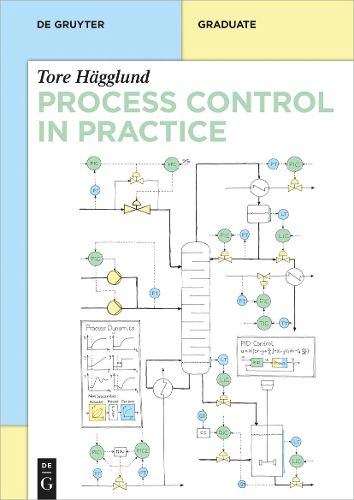
This book covers the most important topics that people working as process control engineers and plant operators will encounter. It focuses on PID control, explains when to use P-, PI-, PD- or PID control as well as PID tuning and includes difficult to control process nonlinearities such as valve stiction or sensor problems. The book also explains advanced control strategies that are necessary when single loop control gives insufficient results.
The key features of the text in front of you are:
This book is a result of teaching the material to industrial practitioners over three decades and four previous editions in Swedish, each of which was a refi nement of the previous one. A key contribution of this book is the careful selection of what is required when you are at a plant and have to make sense of what you see. The book is written in such a way that it does not assume mathematical knowledge above the compulsory school level. Process control sits between control engineering and process or chemical engineering and often there is a distinct gap between the two. By explaining both the fundamentals of control and the processes the book is written to appeal to control engineers and process engineers alike. The book includes exercises and solutions and thus lends itself for teaching in the classroom.
$9.00 standard shipping within Australia
FREE standard shipping within Australia for orders over $100.00
Express & International shipping calculated at checkout
Stock availability can be subject to change without notice. We recommend calling the shop or contacting our online team to check availability of low stock items. Please see our Shopping Online page for more details.
This book covers the most important topics that people working as process control engineers and plant operators will encounter. It focuses on PID control, explains when to use P-, PI-, PD- or PID control as well as PID tuning and includes difficult to control process nonlinearities such as valve stiction or sensor problems. The book also explains advanced control strategies that are necessary when single loop control gives insufficient results.
The key features of the text in front of you are:
This book is a result of teaching the material to industrial practitioners over three decades and four previous editions in Swedish, each of which was a refi nement of the previous one. A key contribution of this book is the careful selection of what is required when you are at a plant and have to make sense of what you see. The book is written in such a way that it does not assume mathematical knowledge above the compulsory school level. Process control sits between control engineering and process or chemical engineering and often there is a distinct gap between the two. By explaining both the fundamentals of control and the processes the book is written to appeal to control engineers and process engineers alike. The book includes exercises and solutions and thus lends itself for teaching in the classroom.
Search our extensive online catalogue.
