Readings Newsletter
Become a Readings Member to make your shopping experience even easier.
Sign in or sign up for free!
You’re not far away from qualifying for FREE standard shipping within Australia
You’ve qualified for FREE standard shipping within Australia
The cart is loading…


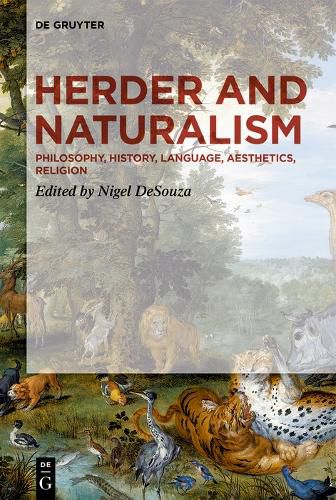
Johann Gottfried Herder did not himself use the term "naturalism", which only appears in the later nineteenth century, but scholars now widely agree that its spirit and intent characterize his thought as a whole. Herder sought to provide an account of human beings that squarely places them in nature. Even though he hastens to clarify that "nature is God in all his works", nature is not to be understood according to divine interventionist principles but rather according to its own immanent principles, such as material and organic forces. The original essays collected here explore the many dimensions of Herder's naturalism: in philosophy, history, language, aesthetics, and religion. Collectively, they illustrate how Herder sought to show that human beings can only properly be understood when they are situated in their spatio-temporal context as linguistic creatures who, through their interactions with each other and their environment, produce the meanings and values that orient them in art, literature, music, customs and practices, but also in economic and political systems and even in religion. This volume sheds light not only on Herder's thought, but also on a line of thought that emerged in the Enlightenment but whose importance has only grown.
$9.00 standard shipping within Australia
FREE standard shipping within Australia for orders over $100.00
Express & International shipping calculated at checkout
Stock availability can be subject to change without notice. We recommend calling the shop or contacting our online team to check availability of low stock items. Please see our Shopping Online page for more details.
Johann Gottfried Herder did not himself use the term "naturalism", which only appears in the later nineteenth century, but scholars now widely agree that its spirit and intent characterize his thought as a whole. Herder sought to provide an account of human beings that squarely places them in nature. Even though he hastens to clarify that "nature is God in all his works", nature is not to be understood according to divine interventionist principles but rather according to its own immanent principles, such as material and organic forces. The original essays collected here explore the many dimensions of Herder's naturalism: in philosophy, history, language, aesthetics, and religion. Collectively, they illustrate how Herder sought to show that human beings can only properly be understood when they are situated in their spatio-temporal context as linguistic creatures who, through their interactions with each other and their environment, produce the meanings and values that orient them in art, literature, music, customs and practices, but also in economic and political systems and even in religion. This volume sheds light not only on Herder's thought, but also on a line of thought that emerged in the Enlightenment but whose importance has only grown.
Search our extensive online catalogue.
