Readings Newsletter
Become a Readings Member to make your shopping experience even easier.
Sign in or sign up for free!
You’re not far away from qualifying for FREE standard shipping within Australia
You’ve qualified for FREE standard shipping within Australia
The cart is loading…


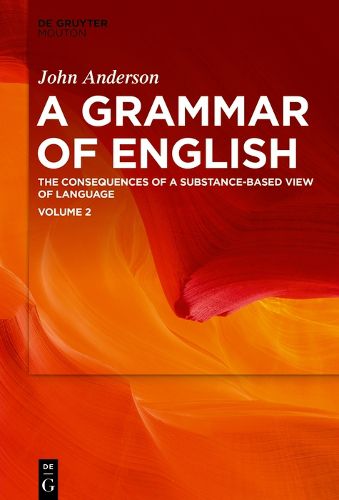
This grammar of English embraces major lexical, phonological, syntactic structures and interfaces. It is based on the substantive assumption: that the categories and structures at all levels represent mental substance, conceptual and/or perceptual. The adequacy of this assumption in expressing linguistic generalizations is tested. The lexicon is seen as central to the grammar; it contains signs with conceptual, or content, poles, minimally words, and perceptual, and expression, poles, segments. Both words and segments are differentiated by substance-based features. They determine the erection of syntactic and phonological structures at the interfaces from lexicon. The valencies of words, the identification of their semantically determined complements and modifiers, control the erection of syntactic structures in the form of dependency relations. However, the features of different segment types determines their placement in the syllable, or as prosodies. Despite this discrepancy, dependency and linearization are two of the analogical properties displayed by lexical, syntactic and phonological structure. Analogies among parts of the grammar are another consequence of substantiveness, as is the presence of figurativeness and iconicity.
$9.00 standard shipping within Australia
FREE standard shipping within Australia for orders over $100.00
Express & International shipping calculated at checkout
Stock availability can be subject to change without notice. We recommend calling the shop or contacting our online team to check availability of low stock items. Please see our Shopping Online page for more details.
This grammar of English embraces major lexical, phonological, syntactic structures and interfaces. It is based on the substantive assumption: that the categories and structures at all levels represent mental substance, conceptual and/or perceptual. The adequacy of this assumption in expressing linguistic generalizations is tested. The lexicon is seen as central to the grammar; it contains signs with conceptual, or content, poles, minimally words, and perceptual, and expression, poles, segments. Both words and segments are differentiated by substance-based features. They determine the erection of syntactic and phonological structures at the interfaces from lexicon. The valencies of words, the identification of their semantically determined complements and modifiers, control the erection of syntactic structures in the form of dependency relations. However, the features of different segment types determines their placement in the syllable, or as prosodies. Despite this discrepancy, dependency and linearization are two of the analogical properties displayed by lexical, syntactic and phonological structure. Analogies among parts of the grammar are another consequence of substantiveness, as is the presence of figurativeness and iconicity.
Search our extensive online catalogue.
